What “silent” DNA changes reveal about biodesign
When AI changes the DNA but keeps the protein, what exactly has stayed the same?
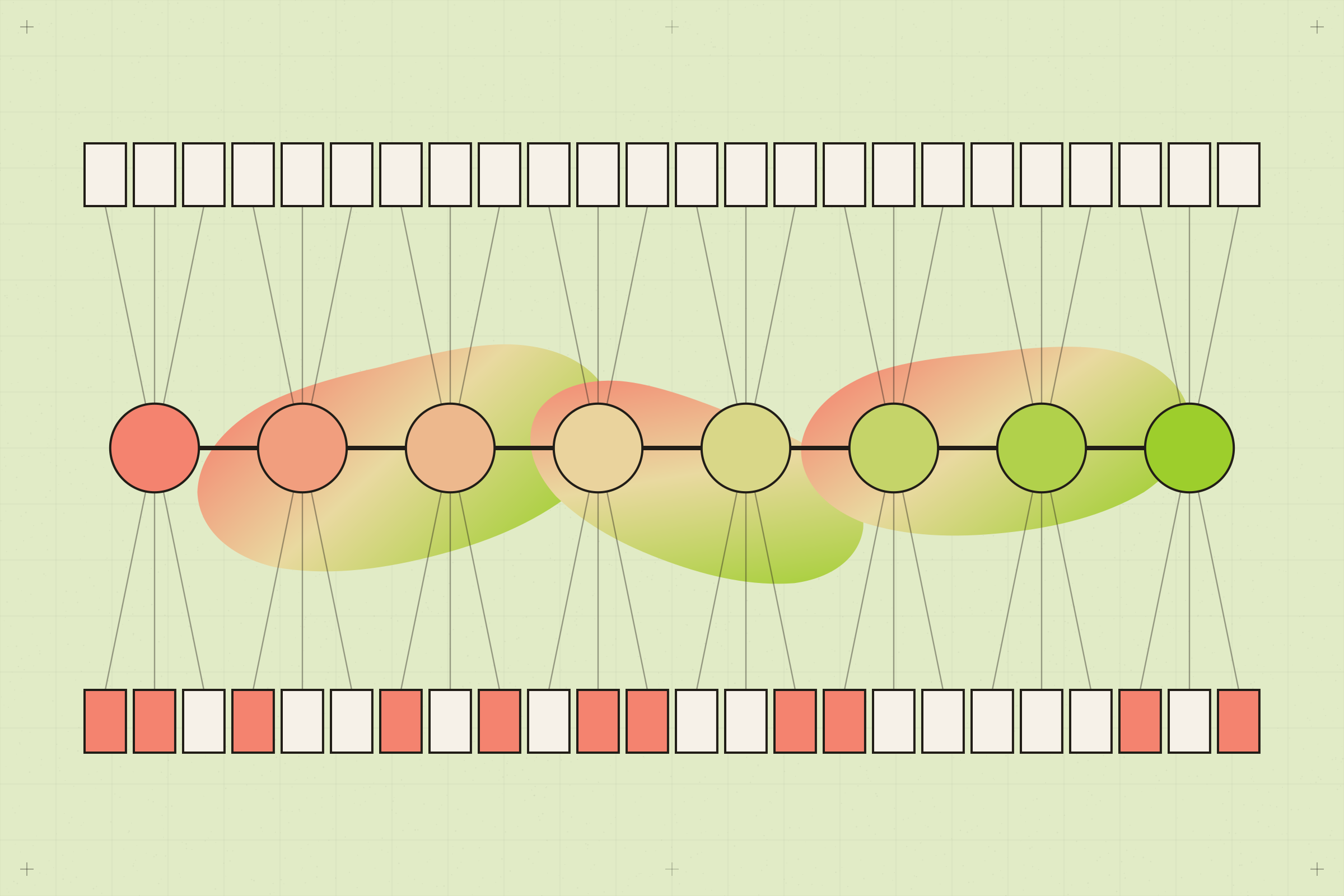
A synonymous DNA change swaps some genetic letters for others without changing the protein those letters describe. These changes are often called silent. Software now uses them to rewrite whole genes, so the living materials designers receive often carry rewritten DNA. If you work with organisms as partners in making, rather than as parts, this raises a question worth holding: when two living things are called “the same”, what was compared to decide it?
Different DNA can spell the same protein
DNA is read three letters at a time. Each group of three, called a codon, tells the cell which building block (an amino acid) to add next. Most amino acids have more than one codon. Alanine, for example, has four.
So one gene can be rewritten many ways and still give the same chain of amino acids. Looking only at that chain, nothing has changed. Hence “silent”.
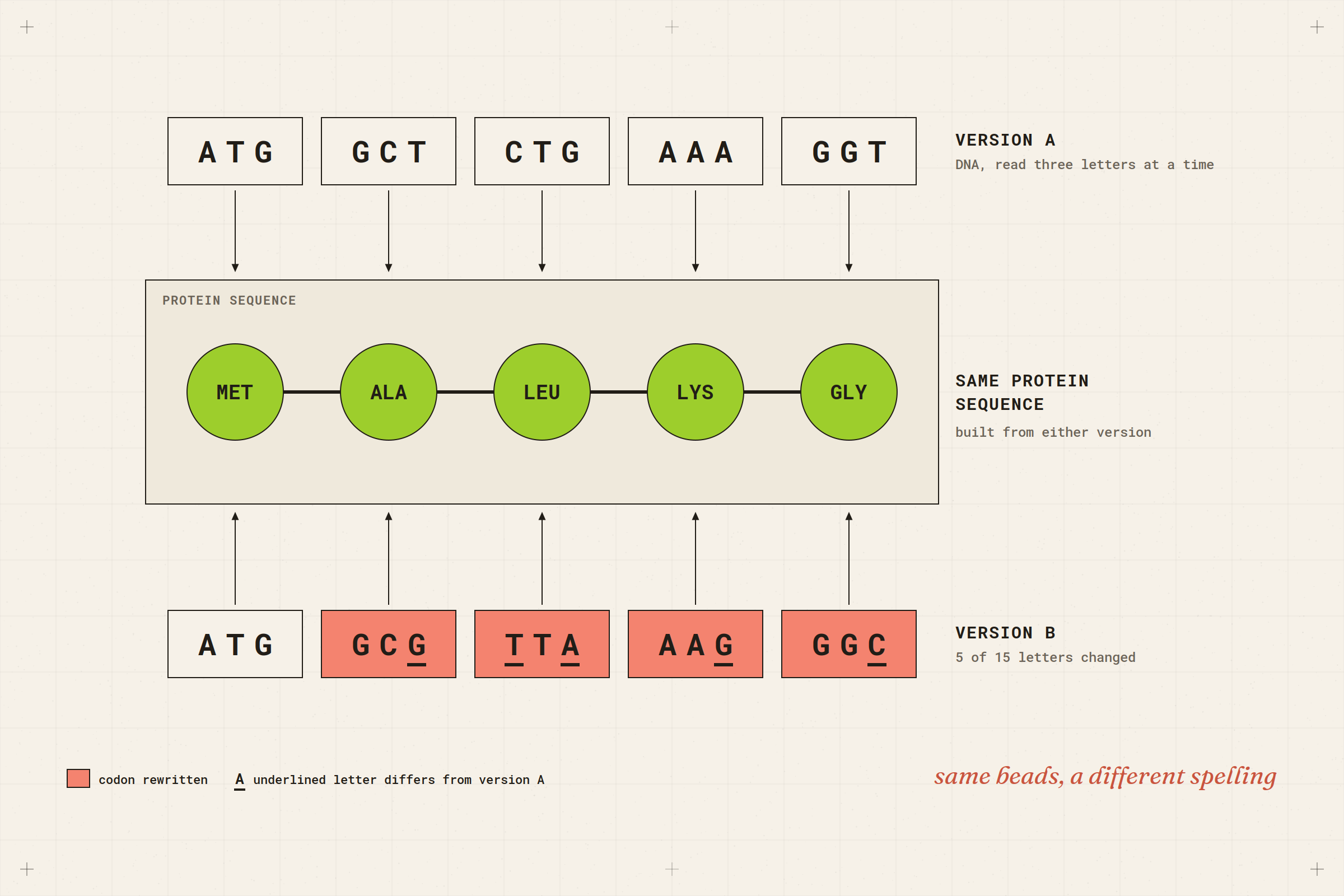
Fig. 1. Different DNA, same protein.
Silent in the sequence is not always silent in the cell
A cell builds a protein codon by codon, and the chain starts to fold while it is still being made. Different codons can change how quickly parts of that chain are produced. The order of the building blocks stays the same. The route by which the chain becomes a working molecule may not. A protein is made in a relationship between a gene and the cell that reads it, so the sequence alone is only part of what it is.
In some experiments, genes that differed only by synonymous changes produced proteins that folded or behaved differently.
Most synonymous changes have no visible effect, so they are not a danger in themselves. But they expose a choice about what counts as “the same”.
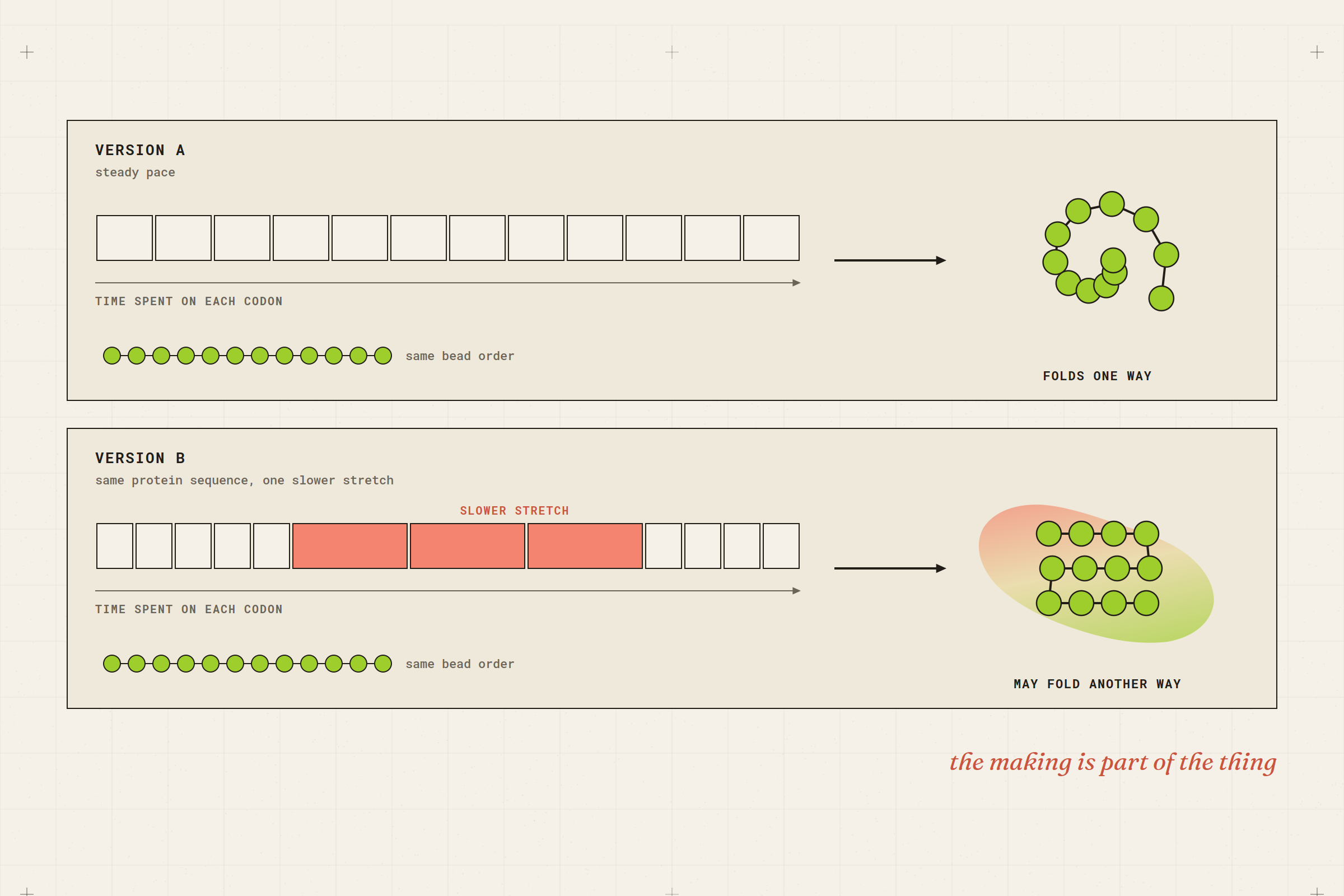
Fig. 2. Same chain, different pace. Illustrative, not a measurement.
Rewriting a gene translates it between species
The most common reason to rewrite a gene is codon optimisation. Each organism has its own preferred codons, a kind of dialect. When a human gene is moved into a bacterium, researchers translate it into the bacterium’s dialect. The host organism shapes the gene it is asked to express.
Software now does this for whole genes, while also raising yield and making the DNA easier to assemble and manufacture. Through all of it, one thing is usually held fixed: the protein sequence. That is sensible engineering. It is also a definition of identity, written into software.
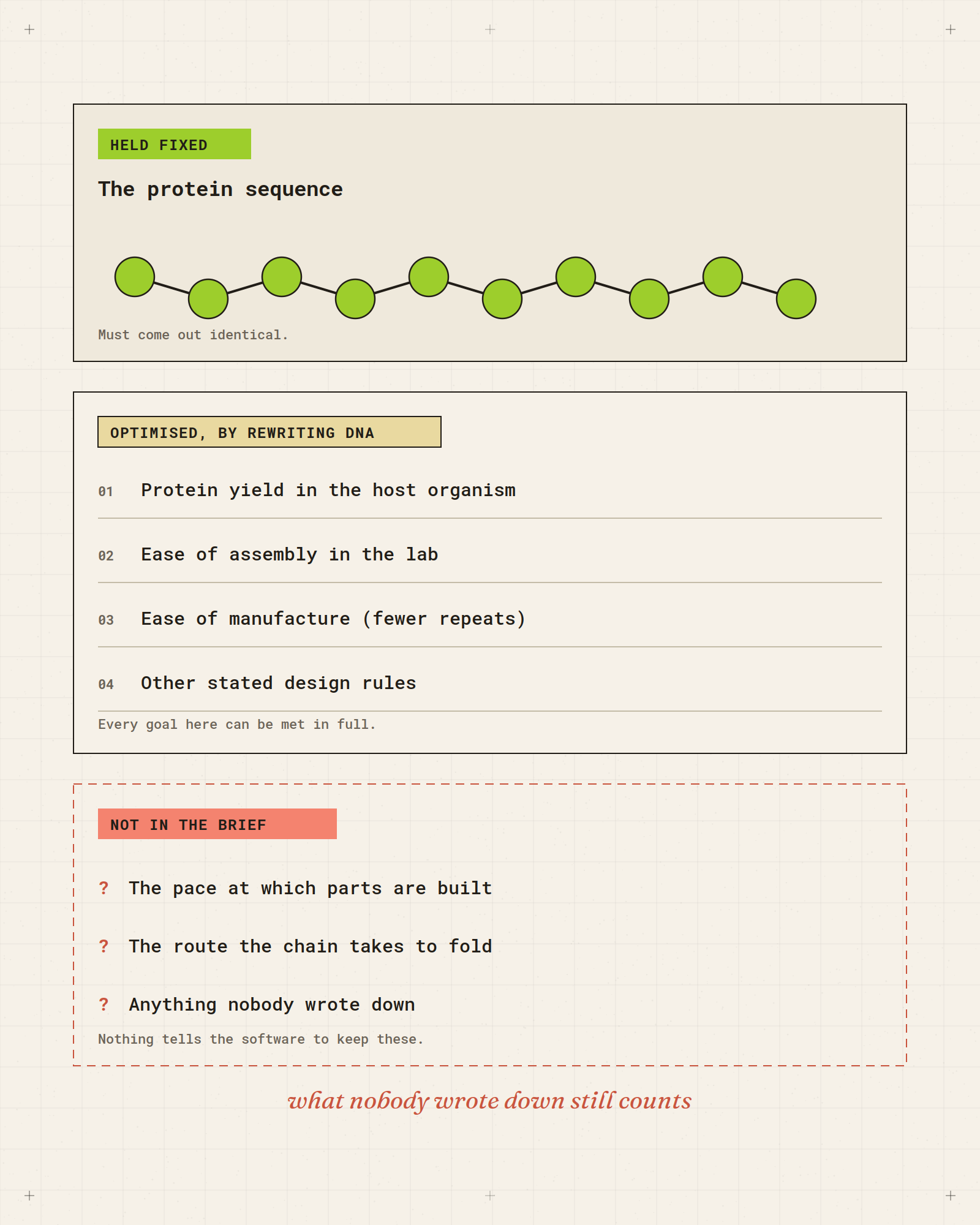
Fig. 3. What the software is told to keep.
An AI tool can meet every goal and still miss what mattered
AI tools now do more of this redesign. Asked to raise yield and keep the protein sequence, a tool can meet every goal. But if the pace at which parts of the protein are built matters, and nobody wrote that down, nothing tells the tool to keep it.
That need not be an AI failure. It can be a successful optimisation of an incomplete definition of sameness. It also repeats an old habit: reducing a living process to the part that is easiest to measure. The question is what we forgot to tell the tool, and what we forgot to notice ourselves.
Your material carries a history of relationships, so trace it
An engineered bacterium, a glowing protein or an enzyme may reach you as a ready-made part. Its DNA may have passed through other organisms, companies, software and researchers. That history is part of the material.
You can find out what it is. Before your next build, take one engineered organism or protein you work with and do three things.
Find its source. Check the supplier page, the plasmid record (the named DNA package it came in) or the paper’s methods.
Look for these phrases: “codon-optimised”, “synthetic gene”, “gene synthesis”, or “optimised for” followed by an organism. (US spelling: “optimized”.)
Write a short DNA history in your project notes: where the DNA came from, whether it was rewritten, for which organism, and what was kept the same.
If your result differs from the published one, check this history first. Keeping it is also a form of care: for the organism, and for the next person who works with it.
When you are told two living things are the same, ask one question back: same in what way?
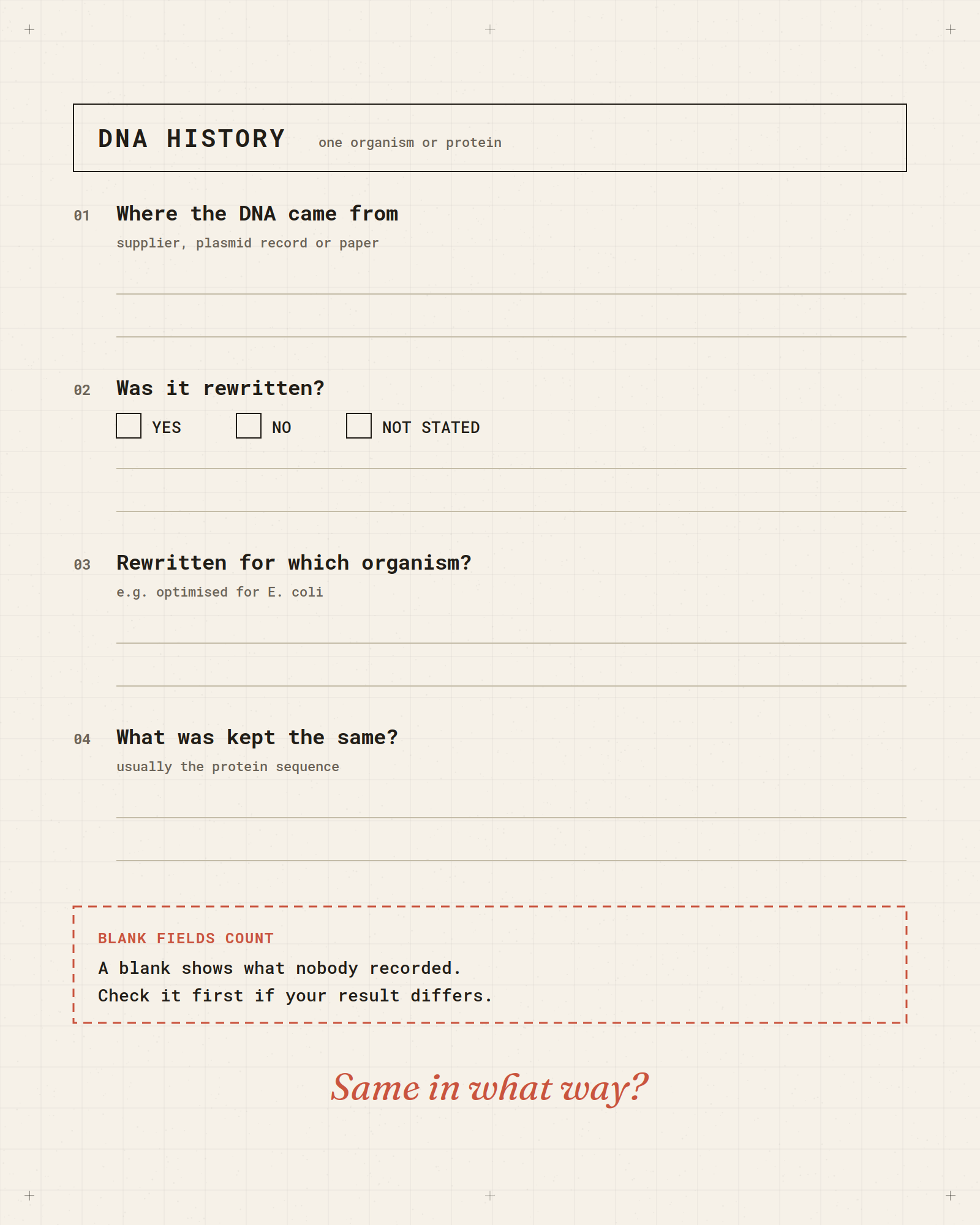
Fig. 4. A DNA history card.
The Biodesign Academy Library
The Library holds separate, longer Readings, each working through one material or question in depth.
Reply with what you found, blanks included. Teaching with this? Write to [email protected].
Kimchi-Sarfaty, C., Oh, J. M., Kim, I.-W., et al. (2007). A “silent” polymorphism in the MDR1 gene changes substrate specificity. Science, 315(5811), 525-528. doi.org/10.1126/science.1135308
Buhr, F., Jha, S., Thommen, M., et al. (2016). Synonymous codons direct cotranslational folding toward different protein conformations. Molecular Cell, 61(3), 341-351. doi.org/10.1016/j.molcel.2016.01.008
Walsh, I. M., Bowman, M. A., Soto Santarriaga, I. F., Rodriguez, A., & Clark, P. L. (2020). Synonymous codon substitutions perturb cotranslational protein folding in vivo and impair cell fitness. PNAS, 117(7), 3528-3534. doi.org/10.1073/pnas.1907126117
