What gypsum reveals about mycelium research — part 1
Reading 03 · Mycelium

What gypsum reveals about mycelium research

Why inherited explanations become more consequential when living materials meet machines, automation and AI.

Raphael Kim · 10 Aug 2026 · Content v1 · 21 min read · 20 min listen
Mycelium · Protocol literacy · AI
From entangled biological system to machine-readable property
From entangled biological system to machine-readable property.
In short

Gypsum is repeatedly described as a pH buffer in mushroom and mycelium protocols. Older Agaricus research shows that gypsum really can lower compost pH, but that is not the same as demonstrating a general buffering mechanism.

This distinction matters increasingly as biodesign moves into machine-mediated fabrication, where an uncertain explanation can become a parameter, an optimisation target or an automated design rule.

Two failure modes run through the article. Mechanism accretion adds causal specificity without adding evidence. Property capture turns a relationship produced by a system into a property assigned to one of its parts.

In this Reading
21 min · free to read as far as the two concepts
01
A recipe line becomes a mechanism
02
Gypsum really can change pH
03
What the literature supports
04
pH change is not buffering
05
Mechanism accretion
06
Property capture
07
From recipe to protocol literacy
08
Fabrication success as explanation
09
The algorithmic wet lab
10
Terminology to process control
11
Evidence states and the check
12
Keep relationships visible

A line in a recipe becomes a mechanism

If you spend enough time reading papers on mushroom cultivation or mycelium-based materials, you begin to notice a small but persistent claim.

Gypsum, calcium sulfate dihydrate, appears in countless cultivation recipes. Sometimes it is listed without explanation. Sometimes it is said to prevent grains or substrate particles from sticking together. Sometimes it is described as a source of calcium and sulfur.

And sometimes it is described as a pH buffer.

This might seem like a minor terminology problem. It becomes more consequential once biological recipes are translated into 3D printing, automated fabrication and computational optimisation.

A skilled grower can compensate for substrate variation through experience, adjusting moisture, aeration or timing without formalising every causal relationship. Machines work differently. A printer, process controller or optimisation model needs variables to be defined.

If gypsum is classified as a pH-control variable, that description can influence what gets measured, adjusted and optimised.

How the progression runs
Inherited explanation
↓  Design assumption
↓  Process parameter
↓  Optimisation target
↓  Automated decision
Automation gives inherited assumptions greater leverage.
There is also a more fundamental problem with assigning an ingredient a single function. Living-material systems are relational. What gypsum does depends on the substrate, organism, microbial community, water, chemistry, temperature and fabrication process around it.

A pH effect observed in alkaline, ammonia-rich Agaricus compost is therefore situated knowledge. It is not necessarily an intrinsic property that travels unchanged with the ingredient.

As biodesign becomes more computational, preserving that context matters. Databases and models encourage categories such as ingredient = function, even when living systems do not behave so neatly.

Gypsum really can change pH

The pH claim is not invented.

Gerrits reported in 1977 that gypsum lowered mushroom-compost pH while slightly reducing nitrogen loss. In his 1988 chapter on Agaricus compost, he again reported substantial pH reductions in an alkaline, ammonia-rich system. Mouthier and colleagues similarly found in 2017 that compost without gypsum reached higher pH and released more gaseous ammonia.

So gypsum can alter pH. But lowering pH is not the same as demonstrating buffering.

A buffer resists pH change when acids or bases are introduced. The original evidence also comes from a very particular straw-and-manure compost system, not sterilised sawdust, grain spawn, hemp hurd or printable living paste.
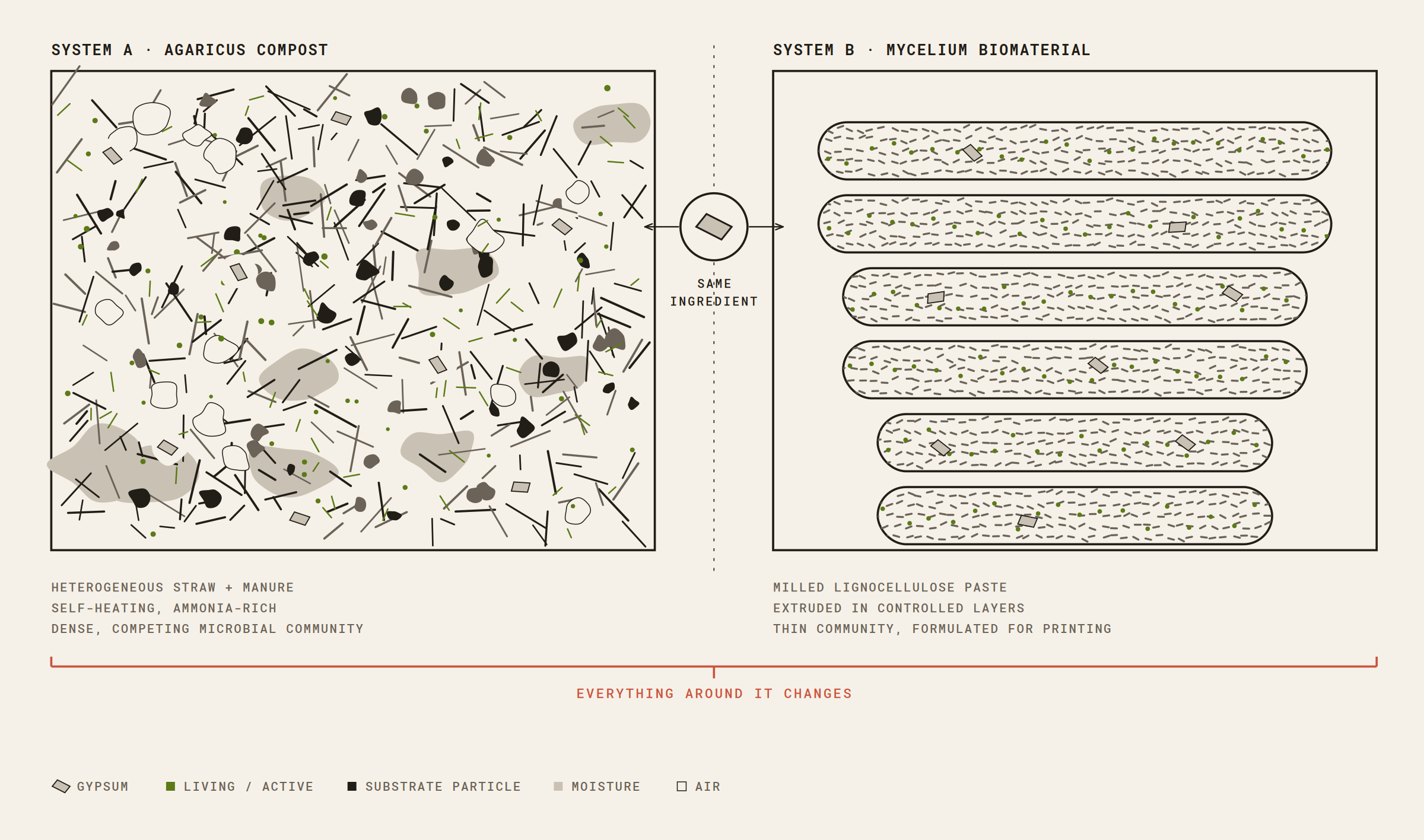
Same ingredient, different system
Fig. 1  Same ingredient, different system
The ingredient travels. The system does not. Gypsum appears in both, and almost nothing else does. The same ingredient appearing in two recipes does not mean it performs the same function in both.
Key: gypsum · living or active · substrate particle · moisture · air

What the literature actually supports

Instead of asking which papers call gypsum a buffer, ask what each source actually demonstrates.

Paper
System
What the evidence supports
Gerrits, 1977
Mushroom compost
Gypsum altered pH and nitrogen loss: a real system effect, not necessarily conventional buffering.
Gerrits, 1988
Agaricus compost
Reports substantial pH lowering and links it to reduced free-ammonia risk in alkaline compost.
Mouthier et al., 2017
Mushroom compost
Removing gypsum produced higher pH and more gaseous ammonia.
Hyde et al., 2019
Review
Shows buffering terminology entering influential review literature, with gypsum and calcium carbonate discussed together.
Alemu et al., 2022
Mycoblocks
Assigns buffering, anti-adhesion and air-circulation roles to calcium sulfate.
Noble et al., 2024
Compost review
Distinguishes an older structural explanation from a newer interpretation centred on sulphate and ammonium chemistry.
Baharlou, 2025
3D-printed living material
Shows gypsum entering a system where fabrication and biological performance coexist.
Akromah et al., 2026
Biomineralised mycelium
Describes gypsum as a calcium and sulfur source and a pH buffer, but does not experimentally isolate those roles.
Table 1  Some papers measure system effects, some interpret mechanisms, some inherit functional descriptions.

Compressing them into gypsum = buffer removes information needed for causal reasoning.

A different pH is not automatically evidence of buffering

Physical structure, aeration, ammonia chemistry, calcium reactions and microbial metabolism can all change measured pH without demonstrating conventional buffering by calcium sulfate.

The distinction is especially important when gypsum and calcium carbonate appear together. Calcium carbonate provides carbonate alkalinity; gypsum does not. If both change together, an observed pH outcome cannot establish which ingredient produced it.

The recipe may work perfectly. The causal explanation can still remain unresolved.
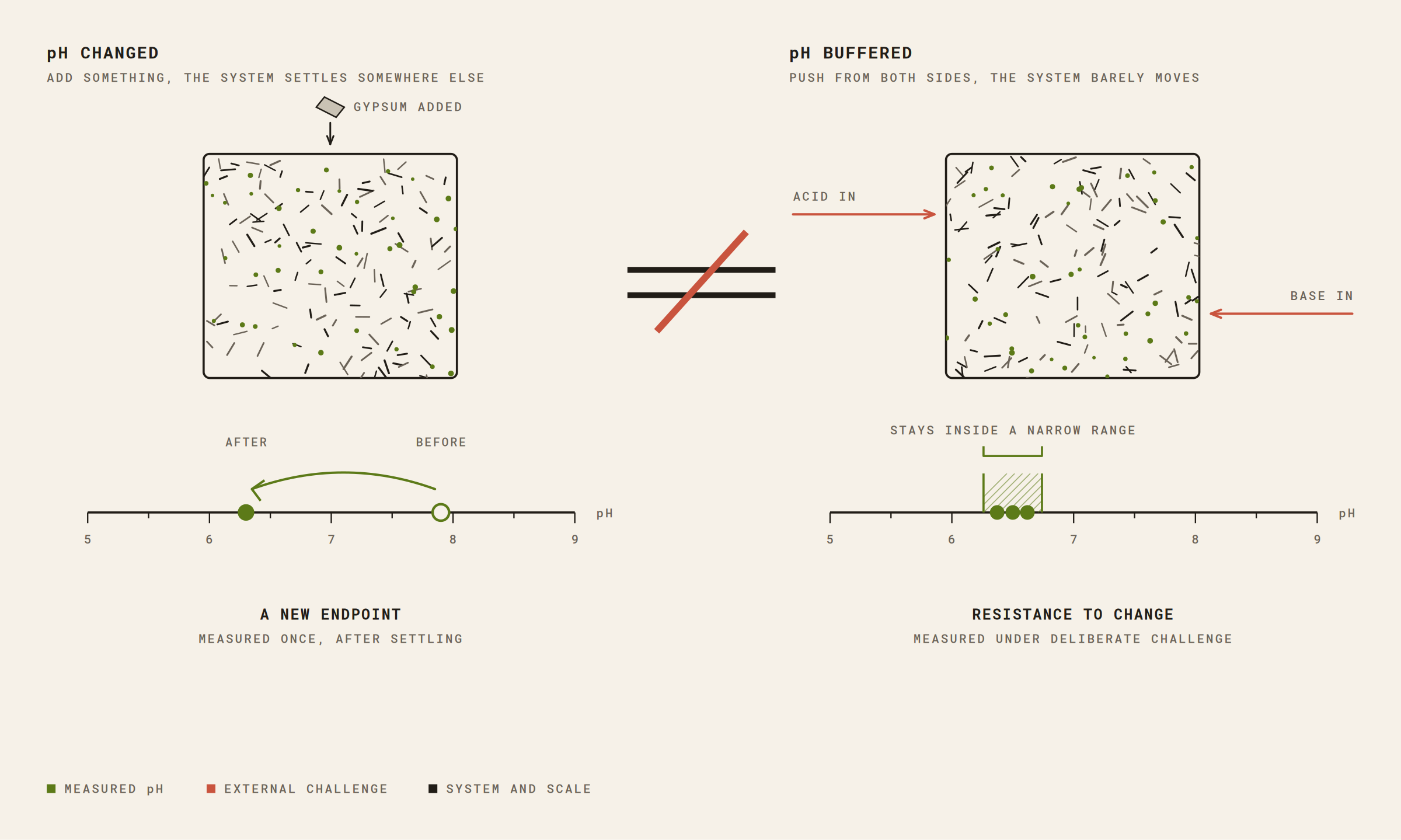
A different pH is not a buffered pH
Fig. 2  A different pH is not a buffered pH
Changing pH and resisting pH change are different observations, though they are often reported as one.
Key: measured pH · external acid or base challenge · system and scale
01
Failure mode

How a useful recipe acquires an explanation

Step 01
“Gypsum is added.”
Step 02
“Gypsum is useful.”
Step 03
“Gypsum regulates pH.”
Step 04
“Gypsum buffers pH.”

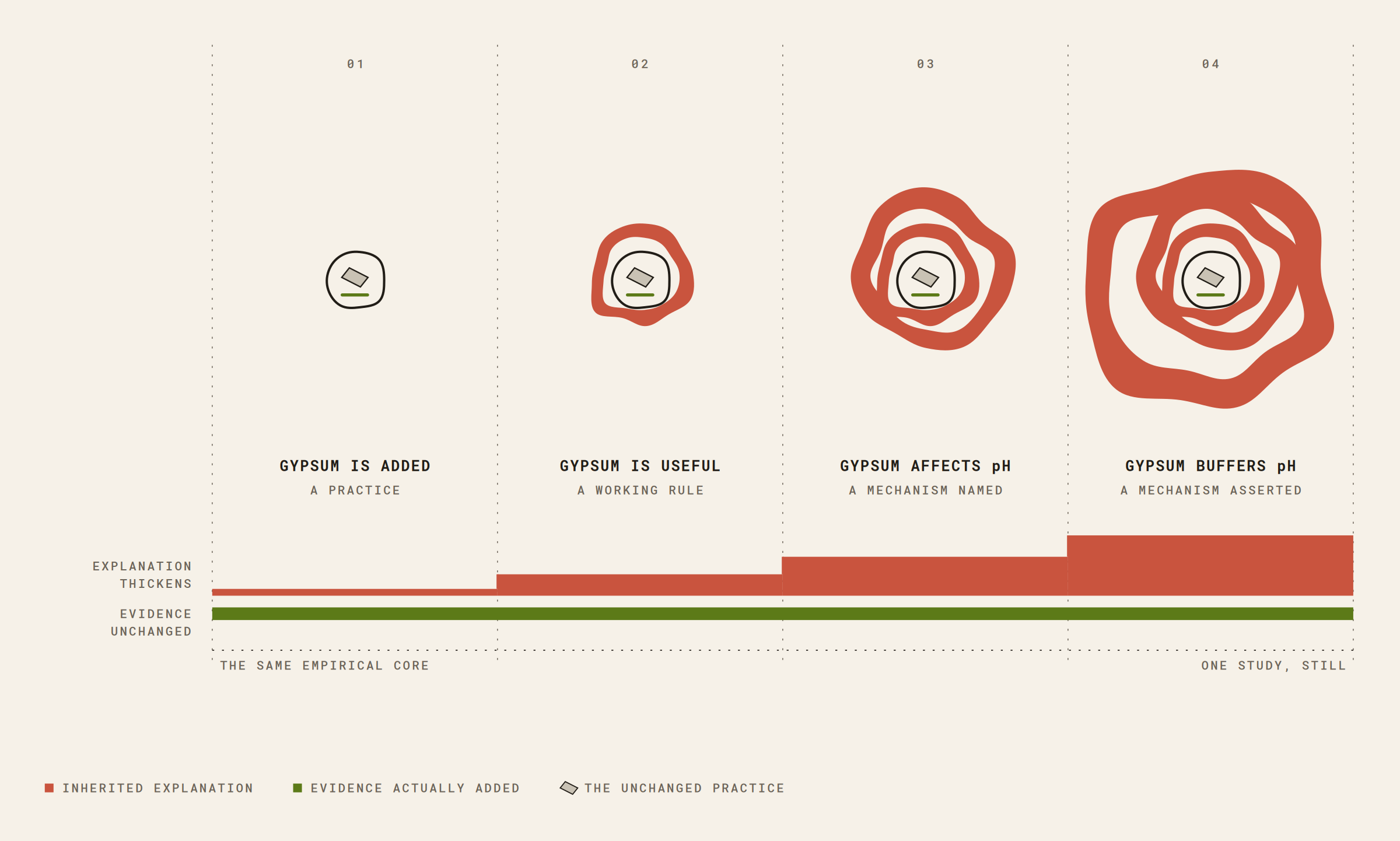
Each retelling makes the explanation more specific. The evidence may not change. No deliberate falsehood is required. The change can happen through citation, summarisation, teaching and protocol inheritance.
Definition
Mechanism accretion is what happens when a causal explanation becomes more specific with each retelling while the evidence behind it stays the same.
Mechanism accretion
Fig. 3  Mechanism accretion
Mechanism accretion is what happens when a causal explanation becomes more specific with each retelling while the evidence behind it stays the same.
Key: inherited explanation · evidence actually added · the unchanged practice
02
Failure mode

When a relationship becomes a property

At the same time as the mechanism thickens, the system disappears. “Gypsum lowered pH in this alkaline Agaricus compost” can become “gypsum is a pH buffer.”

The first statement keeps the system visible. The second turns the relationship into a portable property that can enter a protocol table, database or model.
Definition
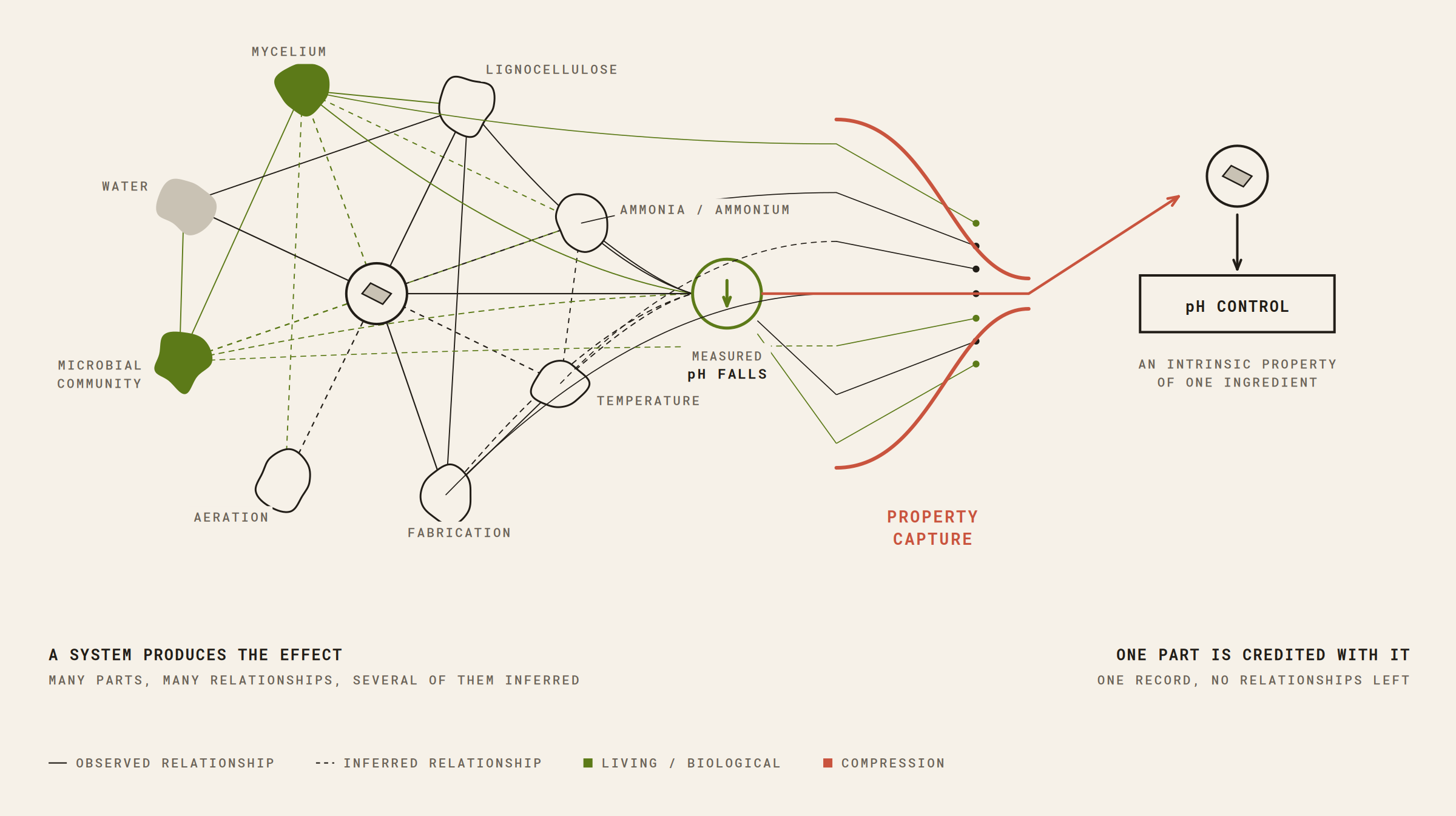
Property capture is what happens when a context-dependent relationship is represented as an intrinsic property or function of one component.
Mechanism accretion adds causal specificity. Property capture removes relational context.
Property capture
Fig. 4  Property capture
Property capture turns a relationship produced by a system into a property assigned to one of its parts. A result produced by the whole is filed under one of its parts.
Key: solid line, observed relationship · dashed line, inferred relationship · living or biological · compression
Members from here
Protocol literacy, the algorithmic wet lab and the evidence-state method.
What happens when a captured property enters a dataset, a model and an optimisation loop, plus the eight-question check and the five evidence states you can teach from tomorrow. Membership opens the whole Library, seven shelves, with a new Reading every week.
Already a member? Sign in
Still to come in this Reading
07  Protocol literacy
08  Fabrication success
09  The algorithmic wet lab