Slime mould memory: what salt reveals about exposure legacy
Why a living material’s history belongs in its specification.
Exposure legacy is a change caused by previous conditions that persists in a living material and can influence its response to later conditions. It does not require learning or the original substance to remain present. If you work with living materials, it is one reason the same recipe can give you two different results.
The term gives a design focus to the broader biological idea of carryover effects: what happens during one period can influence performance during another (O’Connor et al., 2014).
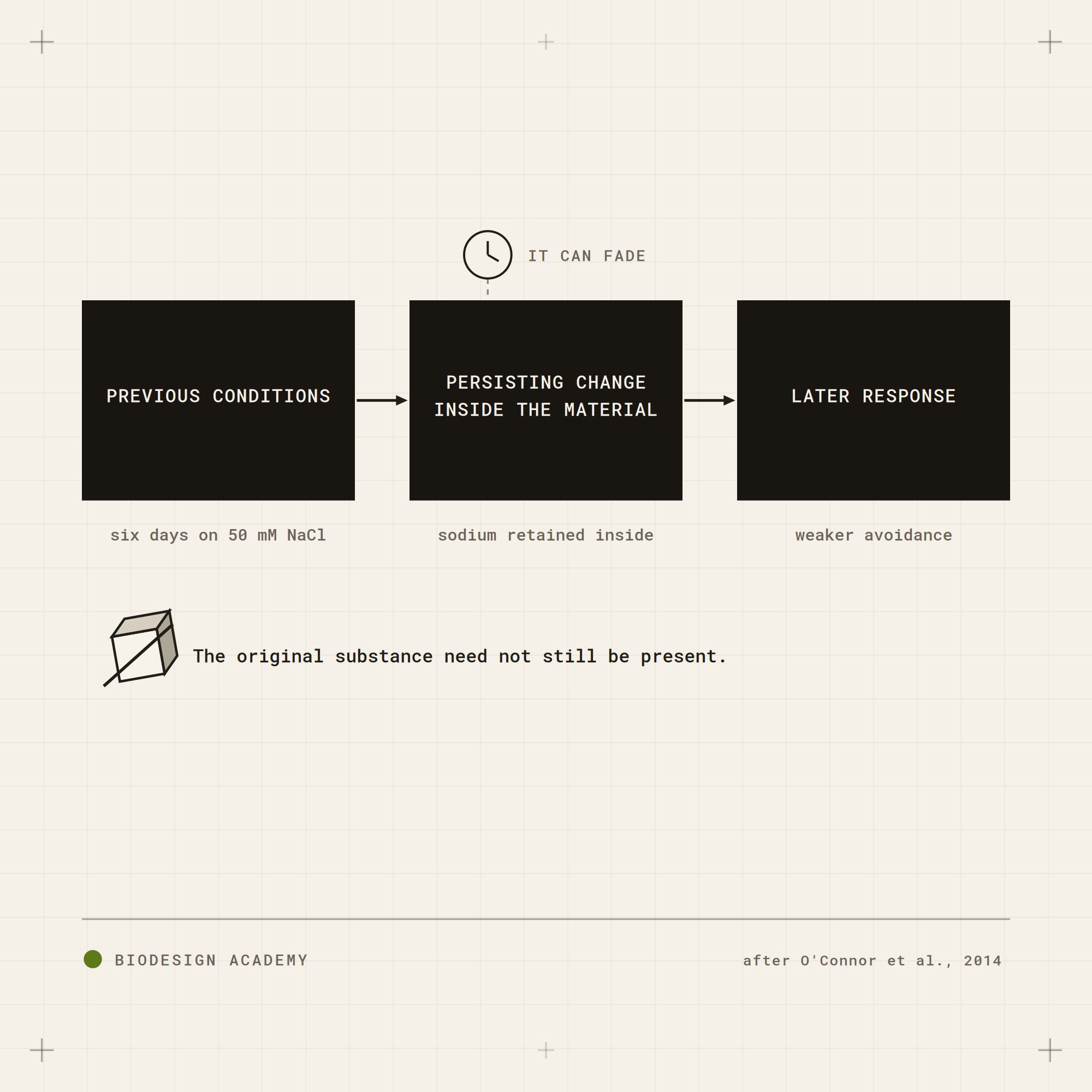
Fig. 1. Previous exposure can leave a change that influences the response to a later stimulus. That change can fade. Retention of the original substance is one possible route, rather than a requirement. Concept informed by O’Connor et al. (2014); salt example from Boussard et al. (2019).
Salt makes this tangible. Sodium chloride, the main ingredient in table salt, can act as a control signal for the slime mould Physarum polycephalum, which avoids sufficiently salty ground. Adamatzky used grains of coarse sea salt to deflect a travelling growth front, split one front into two, and guide two fronts until they merged. Put salt here, and growth goes elsewhere (Adamatzky, 2010).
The routing response also depends on the substrate. In those experiments, the organism spread widely on nutrient-rich gel while avoiding salty areas. On plain agar, growth advanced in more localised fronts. The salt acted within those conditions.
That relationship is useful to a designer. A predictable response can help organise a living material into a pattern or guide it through a structure. But what if yesterday’s salt changes what today’s salt does?
A change caused by previous conditions that persists in a living material and can influence its response to later conditions.
It can. Vogel and Dussutour repeatedly offered Physarum a salty bridge to food. Its reluctance to cross diminished and recovered after a break from salt, consistent with habituation (Vogel and Dussutour, 2016).
The direction of change is not universal. In a different foraging experiment, Smith-Ferguson and colleagues found increasing salt avoidance. Their study only continued testing individuals that repeatedly made the same foraging choice. The tasks, exposure conditions and selection procedure differed, so the findings cannot be treated as a direct comparison. They caution against turning one habituation result into a general rule about salt (Smith-Ferguson et al., 2022).
Boussard and colleagues fed Physarum on oat gel containing 50 mM NaCl for six days. Afterwards, it showed weaker salt aversion and about ten times the sodium content of controls. During recovery, sodium content fell as aversion returned. Here, exposure also changed the organism’s internal chemistry (Boussard et al., 2019).
The part that should interest a designer is what survived a pause.
Previously exposed organisms retained reduced salt aversion after one month of dry dormancy and revival. Their dormant forms, called sclerotia, also retained elevated sodium. This persistence was observed even when external salt was omitted during dormancy induction (Boussard et al., 2019).
A month in storage might mark the separation between two fabrication runs. It need not erase what happened during the first.
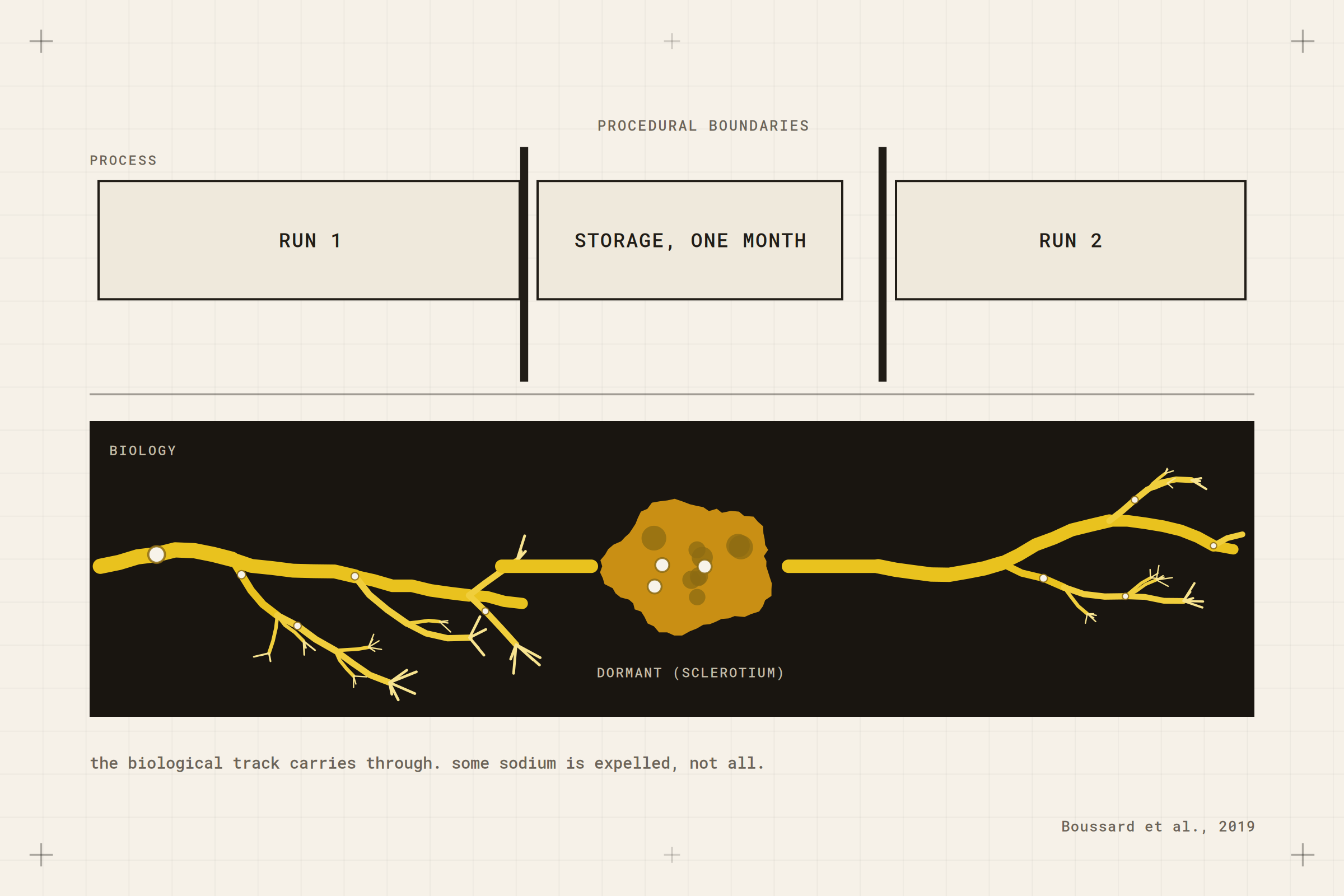
Fig. 2. A conceptual translation into a fabrication workflow: reduced salt aversion persisted through one month of dormancy and revival. A procedural break need not reset exposure history. Based on Boussard et al. (2019).
That distinction matters when deciding where one run ends and the next begins. Storage, transfer and restarting become part of the material’s history. They cannot simply be assumed to return it to its starting condition.
The same consideration applies to testing. Test a living material five times under the same nominal condition, and each test may leave behind a change that affects the next. The fifth reading may reflect changes left by the four before it.
Calibration can change the material being calibrated.
The researchers interpreted the response as habituation, a simple form of learning. Their sodium-uptake intervention supported a role for sodium, without establishing it as the sole mechanism. Exposure legacy provides a broader description for design: an earlier exposure can affect a later response, whether or not every such change qualifies as memory (Boussard et al., 2019).
Which makes this a specification problem. Alongside species or strain, ingredients, geometry and current operating conditions, record what the organism encountered before this run: the substrate, the substance and its concentration, exposure duration and frequency, time since exposure, and what happened in between.
For designers working with mycelium, bacterial cellulose or cyanobacteria, this suggests a question to investigate in each system: could preparation or storage history influence the response you are relying on? The slime-mould findings provide a reason to ask, rather than an answer for every living material.
Two runs can share a recipe and still begin with organisms prepared differently. Where that difference affects the outcome, it belongs in the description of the material.
What has happened to this organism before I ask it to do this?
Reading 06 in The Biodesign Academy Library
Reading 06 examines the routing experiments and supporting evidence in greater detail, with a specification card for recording exposure history and speculative applications across other living materials.
Adamatzky, A. (2010). Routing Physarum with repellents. The European Physical Journal E, 31, 403-410.
Boussard, A., Delescluse, J., Pérez-Escudero, A., & Dussutour, A. (2019). Memory inception and preservation in slime moulds: the quest for a common mechanism. Philosophical Transactions of the Royal Society B, 374, 20180368.
O’Connor, C. M., Norris, D. R., Crossin, G. T., & Cooke, S. J. (2014). Biological carryover effects: linking common concepts and mechanisms in ecology and evolution. Ecosphere, 5(3), 28, 1-11.
Smith-Ferguson, J., Burnham, T. C., & Beekman, M. (2022). Experience shapes future foraging decisions in a brainless organism. Adaptive Behavior, 30(3), 211-221.
Vogel, D., & Dussutour, A. (2016). Direct transfer of learned behaviour via cell fusion in non-neural organisms. Proceedings of the Royal Society B, 283, 20162382.
From the Molecule Up, by Biodesign Academy. Read one living material with care, as a relation you are joining, then meet the next on its own terms.
