The fungus from a rotting tent
Every protein in the databases is there because somebody needed it. That’s worth knowing before you trust an AI tool.
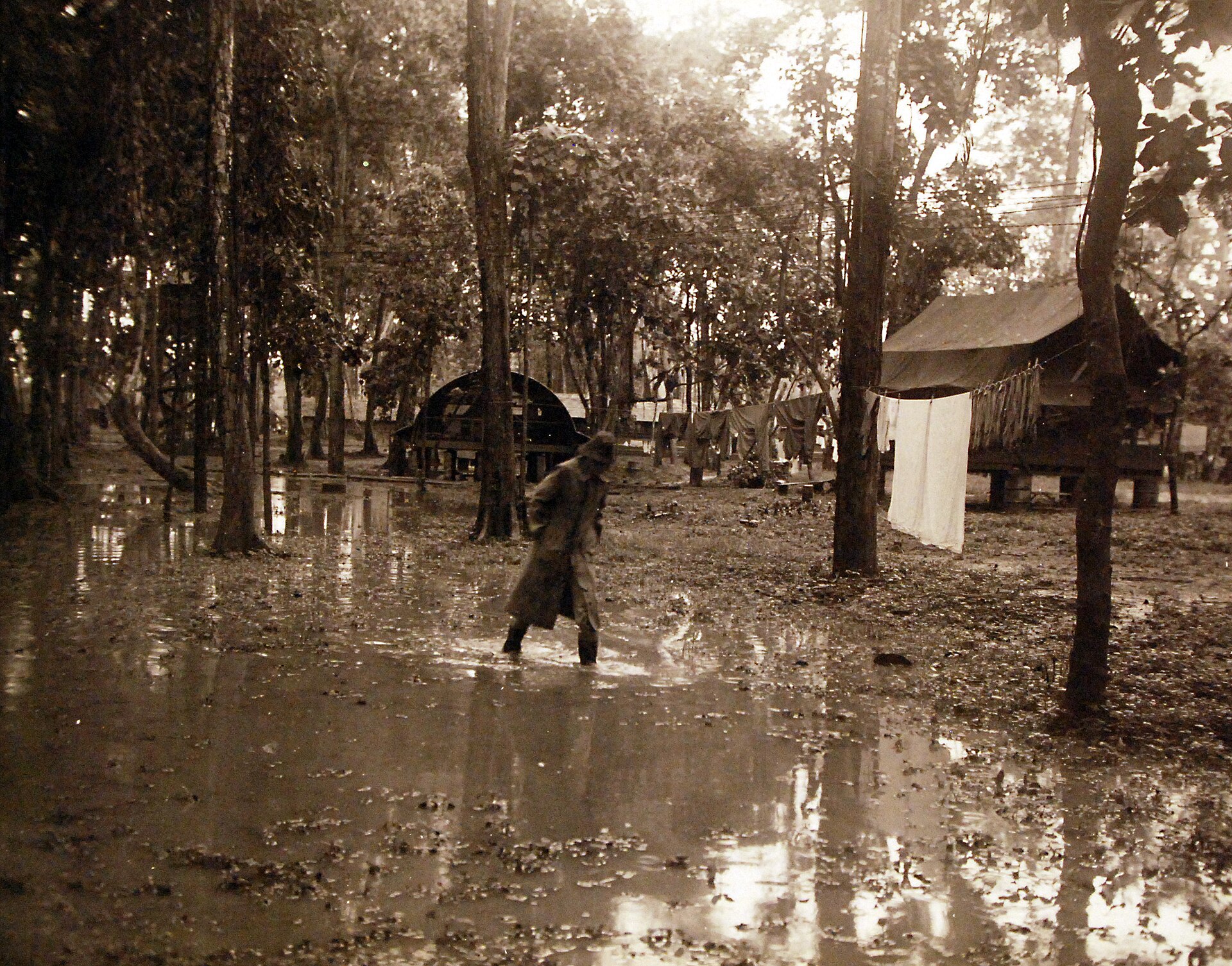
In 1944, US Army tents were rotting on Bougainville, an island in the South Pacific that’s now part of Papua New Guinea.
Something was eating the cotton. Scientists took a sample of the fungus back to the United States and grew it. They named the strain QM6a. It’s Trichoderma reesei, and almost every strain of it used in industry and research today comes from that one sample.
So the fungus entered science as a problem. It stayed because it turned out to be useful: the enzymes it used on those tents now soften denim and turn up in laundry detergents.
One of its small proteins, HFBII, is a hydrophobin. On the fungus it gathers where water meets air and forms a thin, water-repelling film, part of what lets the fungus’s surface shed water.
What HFBII is good for
That film is why people outside mycology care about it. Researchers at Unilever found that a tiny amount of HFBII, 0.1% in water, made foams more stable than any food aerating agent they knew of (Cox et al., 2009). A Finnish team fused it to other proteins so they would stick to surfaces (Linder et al., 2002). Hydrophobins as a family are being tested as coatings that change how a surface takes up water.
For biofabrication the link is closer than it sounds. Mycelium materials get much of their water resistance from hydrophobins. When a team in Utrecht and Delft deleted the main hydrophobin gene of another fungus, Schizophyllum commune, its mycelium went from repelling water about as well as Teflon to soaking it straight up. The material also became 3 to 4 times stiffer (Appels et al., 2018).
That makes HFBII a candidate for something designers keep asking for: a grown coating that helps mycelium, bacterial cellulose or plant fibres shed water, in place of a synthetic finish. As far as I know, nobody has shown that in a finished material yet. It’s a direction, and worth testing.
Why its shape matters
HFBII is about as well known as a protein gets. Its shape has been measured five times in the Protein Data Bank, first in 2003 by a Finnish team. It has also been predicted by AlphaFold, the AI system from Google DeepMind that predicts a protein’s shape from its sequence. AlphaFold rates its confidence in HFBII at 84 out of 100.
Measured means people worked the shape out from experiments. They grew crystals of HFBII, shone X-rays through them and mapped where every atom sits. It’s slow, expensive work, and it’s what AI predictions get checked against.
For a designer, a resolved shape is what turns a protein from an ingredient into something you can design with. The 2003 structure showed a flat, water-repelling patch on one side of HFBII. That one detail explains the film: the patches all turn towards the air and the proteins pack side by side.
It also tells you what to do with it. You can see which way HFBII will face on your material, which parts you can’t touch without losing the effect (four bridges hold it together), and where you might attach something else. Without the shape, you’re mixing and hoping.
Whose need put it there?
All of that knowledge exists because the fungus mattered to someone. First to an army losing its tents, then to companies that wanted its enzymes, then to a food company that wanted better foams.
A protein’s record starts where somebody needed it.
And the record keeps what those people needed. It has the strain number, the sequence, the shape, and the names of the 8 scientists on the 2003 structure.
It doesn’t have much of Bougainville. Germany’s DSMZ, one of the collections that keeps QM6a, lists its country as the Solomon Islands. No entry says who lived where the tents stood, or whether anyone there was asked.
Why it matters when AI is in the room
Scale that up and you get the databases AI tools learn from. They’re full of proteins somebody needed: from humans, lab bacteria, yeast and mice. Many fungi, lichens and algae, the organisms a lot of you grow, have few measured proteins or none.
AlphaFold and other AI protein tools learned from measured shapes. Protein language models do best on the species the databases know best (Ding and Steinhardt, 2024). So an AI tool tends to know your organism about as well as anyone has needed to know it.
That gives you one question to ask before you trust what a tool hands you: whose need put this knowledge here?
If the answer is nobody’s yet, the tool is working from relatives and patterns. Treat its answer as a guess until someone checks.
Try it on your own organism
Pick one protein from something you grow or work with, and trace where what we know about it came from. I made a one-page card for it, the same exercise my course participants did this week.
If your organism turns out to have nobody’s need behind it yet, tell us. We’re gathering those into a public list, Unresolved Companions.
Raphael
In the full Reading for members
The full version of this Reading goes on to four things that aren’t here:
From the rotting tent to the Protein Data Bank: a timeline, maps, photographs, the protein letter by letter, and how its film forms.
Learning outcomes, a minute-by-minute running order, discussion questions on credit, place and fairness, and the misunderstandings to watch for.
A guided walk through UniProt, the Protein Data Bank and AlphaFold: what to look at, what to skip, and what each number means.
All seven questions answered for HFBII, with further reading behind every claim.
Library members get every Reading in full, with teaching notes like these.

