AI-native biodesigner
Speed is the easy part. A model will draw a confident shape for a protein that does nothing.
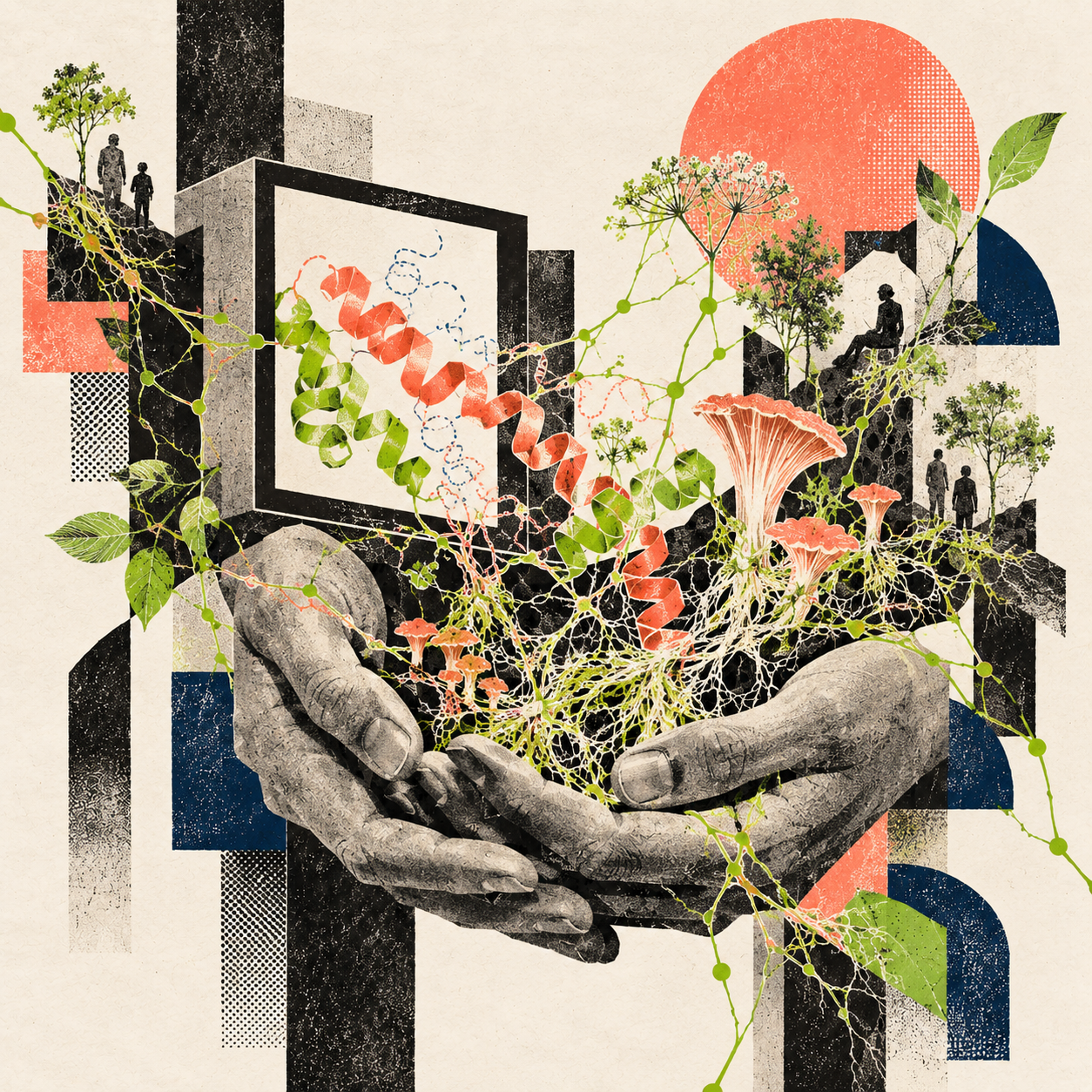
AI models can now draw a protein in minutes. That lowers the barrier to designing with living matter. It also raises a new question: what does a good designer need when the tools are this fast?
This page gives a short answer. It defines one term, AI-native biodesigner, and says what the term asks of a person. It is written for designers, students and teachers who are new to biodesign. You do not need a biology background.
An AI-native biodesigner is a designer of living matter who works with AI models from the start of a project. They can run the tools. They can read what an output shows and what it cannot show. They ask what a change would mean for the organisms and people involved.
The three parts
The definition has three parts. Judgement is the anchor. Fluency and care support it. Each part is something a person can do, so each can be taught and checked. The next section gives a short test for all three.
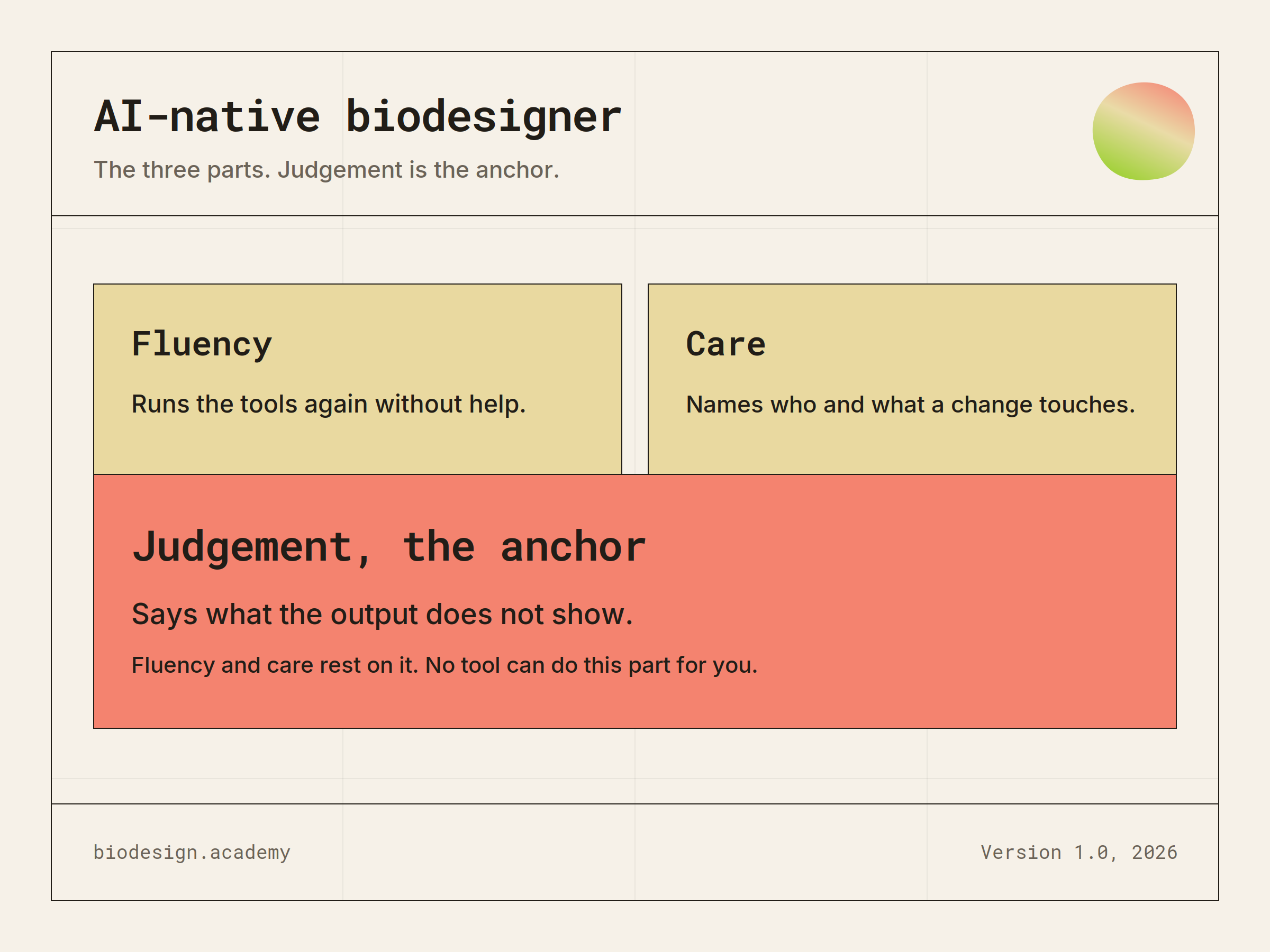
They read a model’s output and say what it shows and what it cannot show. A confident prediction is not a working material. This part cannot be handed to a tool.
They can run the tools without coding and without a lab. They know what a model takes in, what it gives back, and what it costs to run.
Before they make a change, they name who and what it touches: the organism that makes the material, the other organisms it meets, and the people who handle it. This connects to work on epistemic care and shared responsibility in biotechnology ethics (Van de Poel and Robaey, 2017).
How to tell
Three questions, one for each part. Ask them of a project, a student, or yourself.
Judgement. Can they say what the model’s output does not show?
Fluency. Can they run the tool again, on a new input, without help?
Care. Can they name one organism or person a change would touch, and say what test would check the result?
If the answer to the first or the third is no, the work is AI-added, even if the tools were used well. Teachers can use these as a learning outcome and as a marking prompt.
AI-native and AI-added
An AI-added biodesigner keeps the old way of working and uses AI at one step to go faster. An AI-native biodesigner starts with the models in the room. They design around what the models make cheap, which is changing a material. They also design around what the models make easy to get wrong, which is knowing whether the change is any good.
Takes the confidence score as the answer.
AI at one step of a workflow that was already set.
Asks what a change touches once the material exists, if at all.
Says what the output shows and what it cannot show.
Starts with the models in the room and designs around them.
Names the organisms and people a change touches before making it.
What it is not
It is not heavy tool use. Four patterns show the gap between running a tool and reading its result. They are common patterns, not named people.
Reading the score as a verdict. A designer generates variants and picks the one with the best confidence score. The score says how sure the model is about the shape. It does not say what the protein does, or what it would mean for the organism that makes it. Structure predictors report per-residue confidence; see Jumper et al., 2021.
Choosing by looks. A designer generates twenty variants and picks the one that renders best. No one asks which organism makes it, or who would handle it.
Repeating inherited claims. A designer uses AI to summarise papers, then repeats a mechanism without tracing it to a measurement. The explanation gets more specific. The evidence stays the same. See mechanism accretion and property capture.
Saying “AI designed” and stopping. A project calls a material AI designed. The AI is real. No test sits behind the promise.
It is also not a job title or a certificate. It is not a claim that AI replaces lab work. A model can suggest. Someone still has to test. And it is not a biology degree. The skill is reading and asking, and designers can learn it.
Other uses of the term
“AI-native designer” is already used in product and UX design. There it often means a designer who delegates repetitive work to AI, works faster, and spends more time judging what is worth building. Job adverts use it for people who design software products built around AI. Some designers dispute the label.
“AI-native” is also used for tools and infrastructure. A 2026 preprint describes an AI-native autonomous biofoundry for enzyme engineering (Zhang et al., 2026). In a 2026 CHI panel abstract, the author of this page wrote about “AI-native biological tools”, meaning tools that bring opacity and access barriers for novices and cross-disciplinary users (Kim et al., 2026; see also Kim and Zhou, 2025). In those uses the word describes a tool or a system.
Some autonomous platforms are built to reduce or remove the need for human judgement and domain expertise (Singh et al., 2025; Zhang et al., 2026). This page takes the opposite position. In biodesign, judgement is the part that stays with the person.
This page uses the term for a person, and in a narrower way than product design. The anchor is judgement about what a model’s output can and cannot show about a living material, and care for the organisms and people a change touches. Speed and delegation are not part of the definition.
On 4 October 2026 I searched for an earlier definition of “AI-native biodesigner” and did not find one. The term “AI-native” was already used for tools and systems, including in my own 2026 panel abstract (Kim et al., 2026). This page extends it to the person. The search was limited: a few web searches, not Scholar, proceedings or job titles. If you know of an earlier use, please send it and I will add it here.
A worked example
In the Biodesign Academy masterclass “Design your first protein with AI” (1 October 2026), designers pasted an 86-letter hydrophobin sequence into a free browser tool and got a predicted shape in minutes. Then they changed it. Each change came back with a confidence score. Some scores were not what people expected. Working out why was the main lesson.
Running the tool took minutes. Reading the result took the rest of the session.
Questions
No. AI literacy is a general understanding of what AI is and how it works. An AI-native biodesigner uses that understanding in a specific practice: running models on living materials, reading the outputs, and asking what a change would touch. Literacy helps. It is not enough.
Related, but different. In product design the term often centres on speed and delegation. Here the anchor is judgement about a model’s output on a living material, and care for organisms and people.
No. It describes how someone works, not their age. A senior designer can be AI-native. A student may not be. Some people dispute the word even in general design. It is used here because it is the word people already search for. What matters is the definition.
No. The skill is reading a result and asking good questions. Designers can learn it.
No. It is a way of working, with a short test you can apply.
An AI-added designer uses AI at one step of an old workflow. An AI-native designer starts with the models, and checks what their output cannot show.
Related terms
Jumper, J., Evans, R., Pritzel, A., Green, T., Figurnov, M., Ronneberger, O., et al. (2021). Highly accurate protein structure prediction with AlphaFold. Nature, 596(7873), 583–589.
Kim, R., Chen, Y., Ramirez-Figueroa, C., Zhou, J., Telhan, O., Nicenboim, I., Dade-Robertson, M., Pevere, M., & Robaey, Z. (2026). Biodesign x AI: Interactions in the Algorithmic Wet Lab. In Extended Abstracts of the 2026 CHI Conference on Human Factors in Computing Systems (CHI EA ’26), April 13–17, 2026, Barcelona, Spain. ACM, New York, NY, USA, 6 pages. doi.org/10.1145/3772363.3790105
Kim, R., & Zhou, J. (2025). Inclusive Molecular Sketching: Accessibility Barriers in AI-Driven Protein Biodesign Workflows. In Proceedings of the 28th International Academic Mindtrek Conference (Mindtrek ’25). ACM, New York, NY, USA, 400–404. doi.org/10.1145/3757980.3762124
Riffle, D., & Rubery, P. (2026). Biodesign Buddy: Integrating Generative Artificial Intelligence in Academic Biodesign. bioRxiv. doi.org/10.64898/2026.03.11.710906
Singh, N., Lane, S., Yu, T., Lu, J., Ramos, A., Cui, H., & Zhao, H. (2025). A generalized platform for artificial intelligence-powered autonomous enzyme engineering. Nature Communications, 16, 5648. doi.org/10.1038/s41467-025-61209-y
The Designer’s Field Guide. Being an AI-native designer isn’t what you think it is. thedesignersfieldguide.substack.com
Van de Poel, I., & Robaey, Z. (2017). Safe-by-design: From safety to responsibility. NanoEthics, 11(3), 297–306.
Zhang, C., Yang, L., Qin, Y., Li, D., Dong, S., & Yang, M. (2026). An AI-Native Biofoundry for Autonomous Enzyme Engineering: Integrating Active Learning with Automated Experimentation. bioRxiv preprint, posted 1 February 2026, not peer reviewed. doi.org/10.64898/2026.02.01.703093
Kim, R. (2026). AI-native biodesigner. Biodesign Academy Glossary. https://www.biodesign.academy/ai-native-biodesigner
