What citric acid reveals about bacterial cellulose
Role overshadowing: when the job we assign an ingredient is correct, and its correctness is what stops us looking any further.
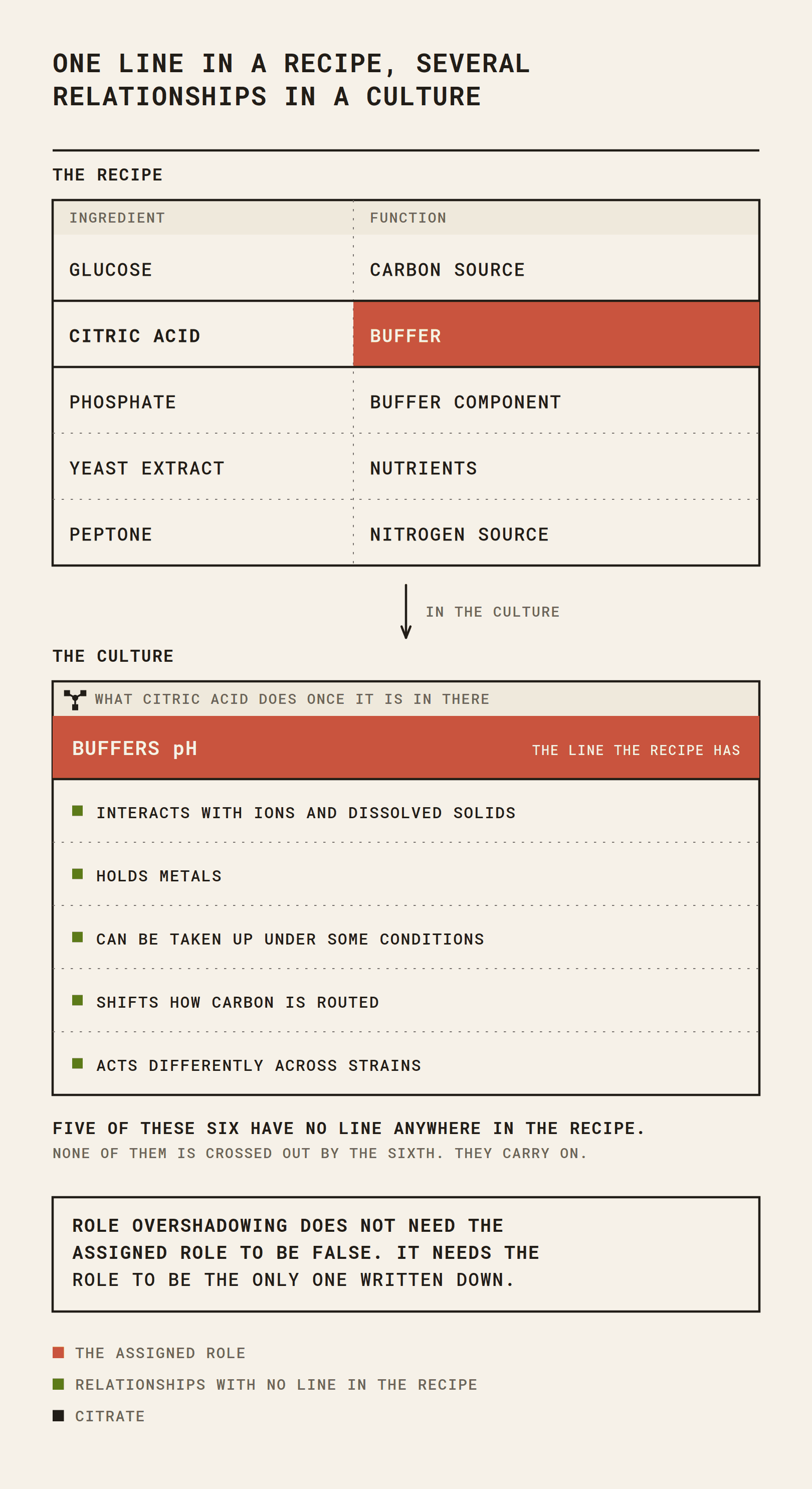
Citric acid sits in the standard recipe for growing bacterial cellulose, and every protocol that gives it a job calls it a buffer. That is chemically true. It is also the only thing most protocols say about it.
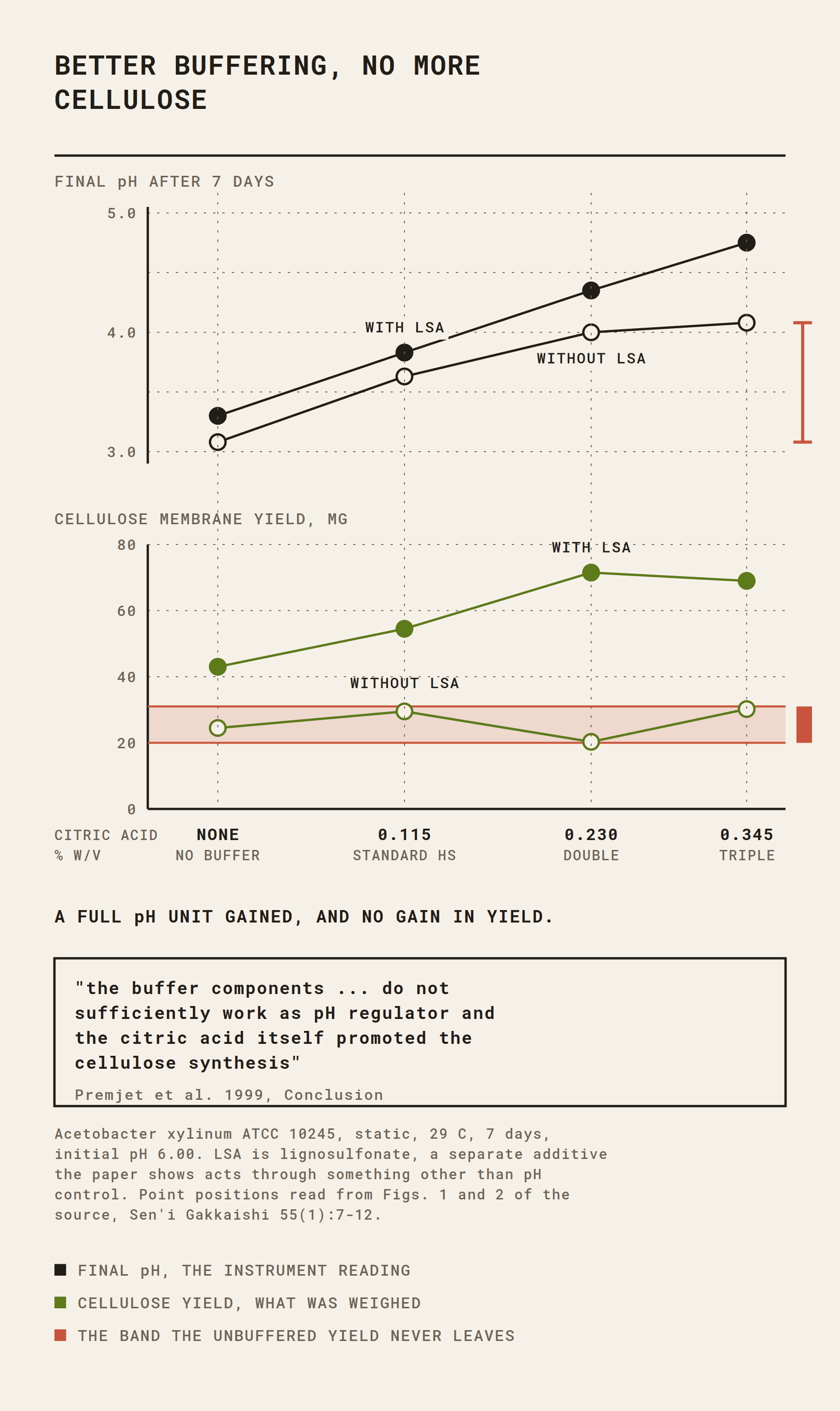
In 1999 a group working across Thailand and Japan tested it. They raised the buffer level until the pH held a full unit better, and the cellulose yield did not move. Their conclusion says the buffer components “do not sufficiently work as pH regulator” and that the citric acid itself promoted the synthesis. Nobody downstream picked that up. The label carried on.
In 2024 a strain whose pH barely dropped still doubled its yield when citrate went in. Whatever citrate is doing, pH does not cover it. I call this role overshadowing. Swap the ingredient and you have changed the environment, even when the meter reads the same.
There is a short, free explainer of the term, written for someone arriving without the full case: Can I replace citric acid in a bacterial cellulose medium?
Sections 03–13 and the references continue in part 2.
A bacterial-cellulose recipe can look reassuringly modular.
This is useful. Recipes have to simplify biology to make it workable. The problem starts when a label is correct enough that we stop asking what else might be happening.
Citric acid is a good example. In bacterial-cellulose media, citrate and phosphate can help control pH. The researchers behind the classic Hestrin-Schramm medium clearly understood this buffering chemistry (Hestrin & Schramm, 1954). So if a protocol describes citrate as part of the buffer system, that is not necessarily wrong.
But several design decisions can follow from that description.
Replace citrate if another buffer maintains the same pH.
Increase citrate if the culture becomes too acidic.
Automate citrate dosing according to a pH sensor.
Ask an optimisation system to find an equivalent buffer.
All are reasonable if buffering captures everything about citrate that matters to the culture. The evidence suggests it does not. The buffering role is chemically legitimate. But once citrate enters a living culture, buffer is no longer a complete description.
The organism encounters a molecule, not a recipe label.
The buffer works, but that does not explain the culture
Hestrin-Schramm medium, one of the best-known formulations for growing bacterial cellulose, contains glucose, peptone, yeast extract, disodium phosphate and citric acid, starting at around pH 6 (Hestrin & Schramm, 1954). A useful experiment by Premjet and colleagues later treated citrate and phosphate explicitly as the buffer system and investigated what happened when those components were changed (Premjet et al., 1999).
A simple model might predict: better buffering, so better pH control, so better growth conditions, so more bacterial cellulose. That is not what happened.
Under their conditions, standard HS medium started at about pH 6 and fell to roughly pH 3.7. More importantly, changing citrate and phosphate produced different effects on cellulose production. Improving the buffering conditions did not simply produce more cellulose (Premjet et al., 1999).
The distinction matters.
The first does not automatically establish the second. Premjet and colleagues suggested that metabolism, the chemical processes through which an organism uses nutrients and produces energy and material, might help explain some of the differences. But they did not fully establish one mechanism.
A correct account of why an ingredient was added does not necessarily explain everything that happens after it enters a living system.
The role does not need to be false. It only needs to become so convincing that we stop looking beyond it.
Better pH control changes other things too
A 2021 study using Komagataeibacter hansenii makes this problem even clearer. Li and colleagues compared different buffer systems and concentrations. At relatively low ionic strength, substantial cellulose could still be produced even though the culture acidified considerably. When buffer concentrations were increased enough to stabilise pH more strongly, cellulose synthesis could collapse (Li et al., 2021).
The important point is that the experiment did not isolate pH as the only thing changing. Increasing buffer concentration also changed the ionic environment of the culture. So the study should not be read as evidence that citrate itself suppresses bacterial cellulose. In fact, one of the lower-ionic-strength phosphate conditions still contained citrate and produced substantial cellulose.
Optimising one measurable parameter can change other parts of the biological environment at the same time.
That is a design principle far beyond citrate. We often make substitutions by matching one measurable property: same pH, therefore equivalent medium; same moisture, therefore equivalent substrate; same stiffness, therefore equivalent scaffold.
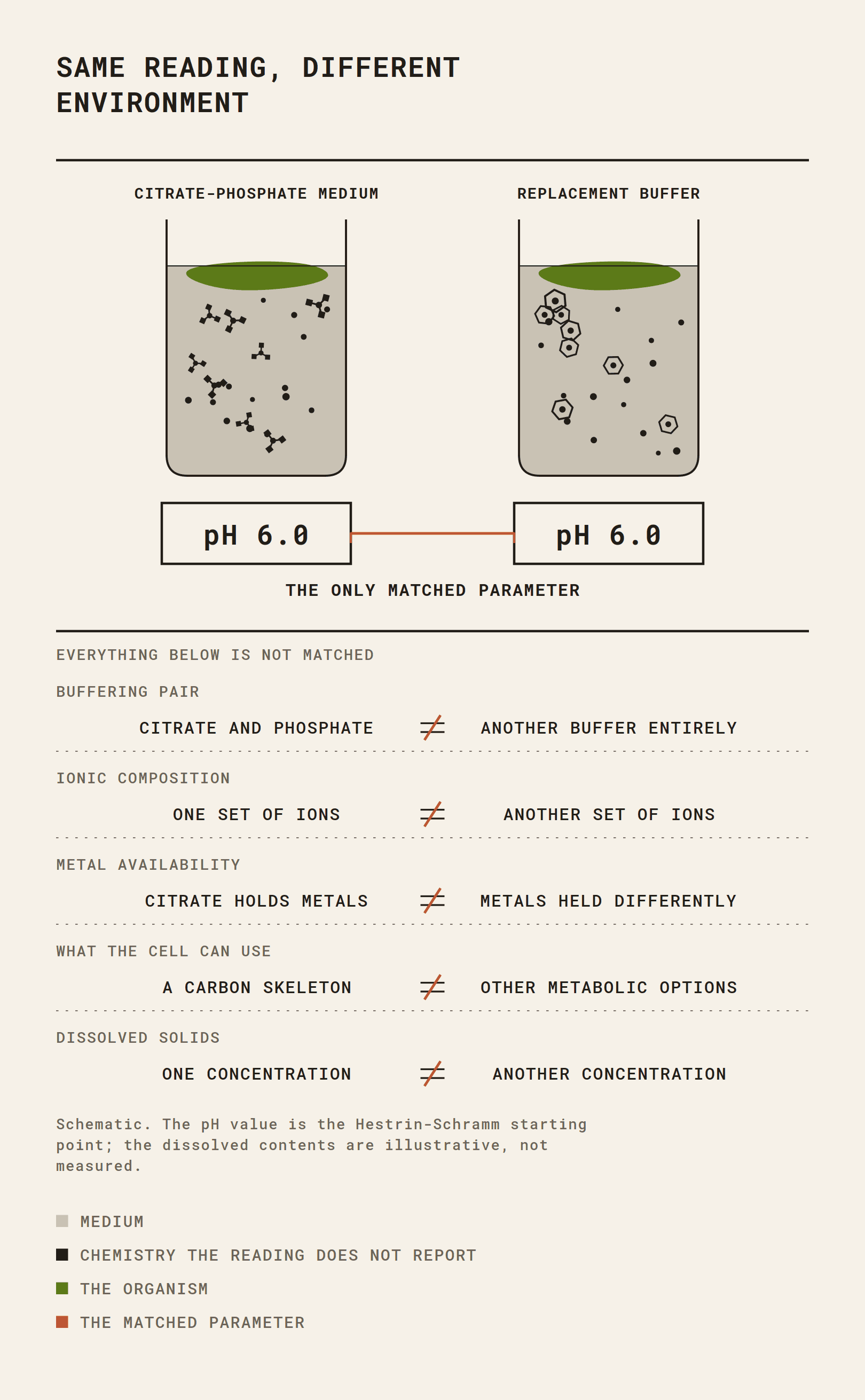
Matching parameters is essential in experiments. But matching one parameter does not make two biological environments identical. A pH meter tells us something important about a medium. It does not tell us which molecules are available to the organism, which ones it can use, how concentrated the dissolved salts are, or what other chemical relationships have changed.
So if we replace citrate-phosphate with another system that maintains exactly the same pH, we may still have changed:
which molecules are available;
the salts and ions in the medium;
access to some metals;
the concentration of dissolved material;
what the organism can use or process.
The replacement may work perfectly well. It may even work better. But it is not biologically neutral simply because the pH matches.
The citation trail behind the citrate-as-buffer explanation, traced document by document with what each source states about citric acid and what it justifies, is deposited as a dataset: https://doi.org/10.5281/zenodo.21985658
04 Strain matters
05 Substitution as ecological intervention
06 Mechanism accretion and role overshadowing
07 Protocols entering design
08 The SCOBY case
09 Reading biological recipes
10 Role overshadowing
11 What this borrows
12 AI and automation
13 The recipe as biological model
— References
