Mycelium, from the molecule up
One property of one matter, walked all the way down, from the thing you can hold to the molecule doing the work.
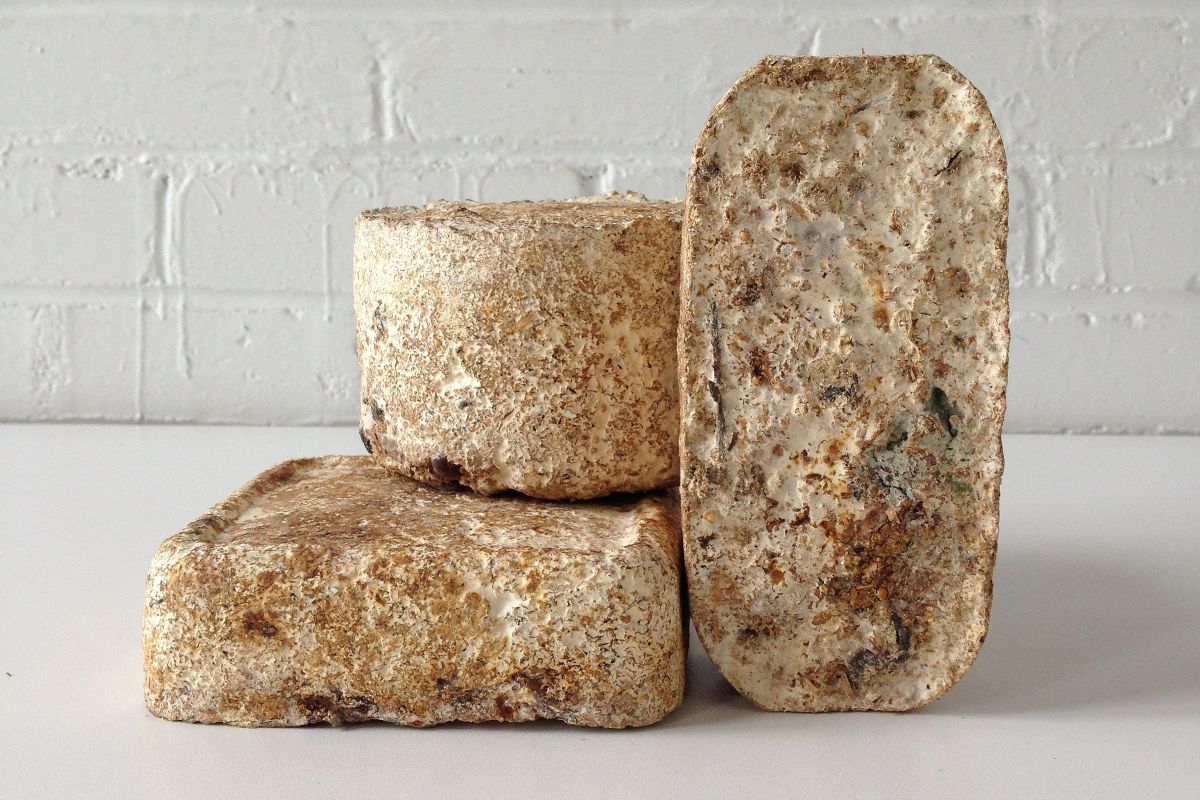
You meet mycelium as a grown solid. Loose stuff goes into a shaped container, sawdust, hemp, straw. The fungus grows through it for a week or two. It comes out as a light, firm block, or a leather-like sheet.
It binds. A bag of loose waste becomes something that holds its shape and takes a footstep. That is not the only thing mycelium does, and it may not be the thing that drew you to it. It is the one this read follows, because a read that follows one property gets somewhere and a read that follows five does not.
This page is the floor of the mycelium shelf, the one the Readings stand on. Foundational is a position in the library, not a promise that the reading is easy.
No biology training. If you can read a plain sentence about a molecule, you can read this.
A guide to growing your own block. Nothing here tells you how to run a batch.
Designers, educators and students who have the material in the room and want to know what is doing the work.
Teaching a room that is meeting biology for the first time is a different job, and it needs material built for that job. Biodesign Academy makes it for courses. Write to [email protected] and say what you teach and who you teach it to.
A primer walks one property of one material all the way down, from the thing you can hold to the molecule doing the work. Name the property, find the actor behind it, look it up, read what it does. No lab. A search, a model you can ask, a few public databases. It is a worked demonstration, not a checklist to fill in.
A note on one word. Makers call the shaped container a mould. It is the same spelling as the fungus that grows on old bread and has nothing to do with it. This page says container throughout, to keep the two apart.
The property, named plainly
Start with what the material is being asked to do.
In most mycelium work something loose has to become something solid, and the fungus is what makes that happen. Warmth, low weight, some fire resistance, the smell of a forest floor, the fact that it grew instead of being manufactured. All of that is real, and any of it might be why the material is in the room at all. This read sets it aside for now.
Binding is the one to follow first, for two reasons. It is the property most technical claims about mycelium rest on, so it is where a claim can actually be checked. And everything else has to sit on top of it, because a block that does not hold together is not yet a material.
Everything below is an answer to one question. What carries that.
What carries the binding
The fungus grows a dense web of fine threads called hyphae. They run through the loose material, wrap around each particle and knit the whole bag into one continuous net. It is closer to felt than to glue. Nothing is being stuck on. The threads are simply everywhere, and everything is caught in them. The fungus also feeds on the plant matter as it goes, and some of what it breaks down cross-links where surfaces meet, so there is a little real adhesion as well. Most of the strength is the tangle.
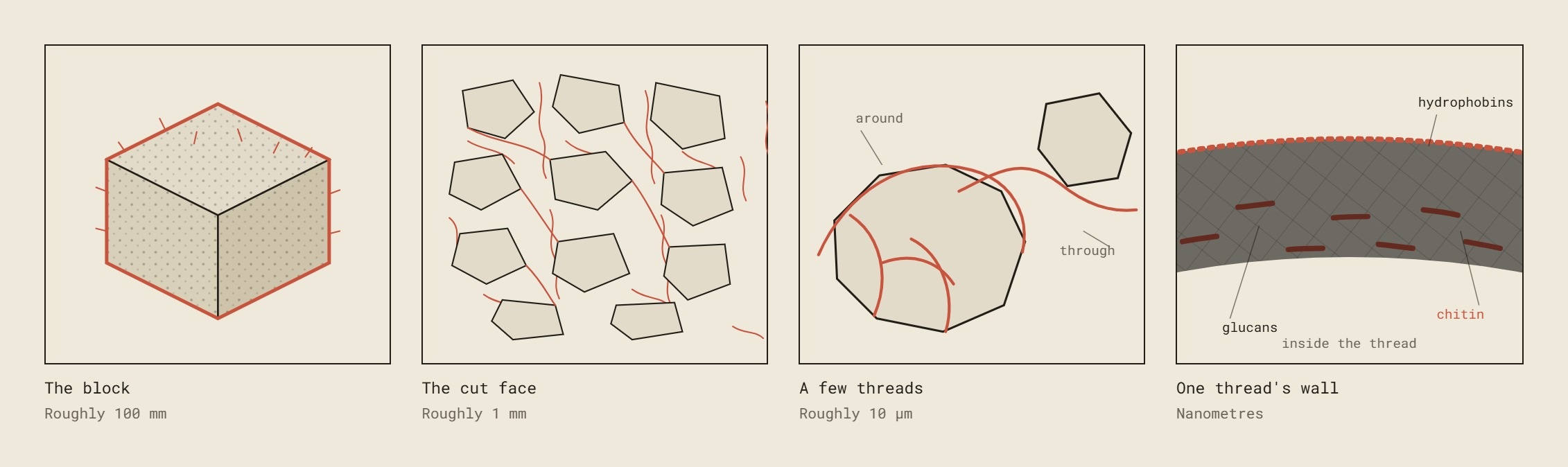
Fig. 2 The accent marks the fungal thread, and only the fungal thread, in all four panels. Follow it down four orders of magnitude and the title of this page stops being a slogan. The fungus is drawn as the minority it is: around five per cent of the mass, not the dense white mesh most illustrations show.
Alt text: Four schematic panels. A block with a thin skin; a cut face of substrate particles with sparse threads between them; hyphae wrapping around and passing through one particle; a cross-section of one thread's wall, showing a hatched glucan matrix, a few chitin fibres and a dotted hydrophobin coat.
Each thread is wrapped in a wall. Between a half and two thirds of that wall is a family of sugars called glucans. Running through them is a smaller amount of chitin, roughly a tenth, the same fibre that stiffens a crab shell. Chitin is the reinforcement and the glucans are the matrix holding it, so chitin does more than its share suggests. In an insect the same fibre is only half the story, because the shell hardens when the protein around the chitin is chemically tanned.
The threads are coated in small fungal proteins called hydrophobins, water-repelling on one face and water-loving on the other. Their main work is to break the surface tension of water so threads can rise into the air, and to leave those aerial threads with a water-shedding skin. They also help hyphae hold on to surfaces.
So the binding is two things at once. The net, and the wall around each strand of it.
Read what it does
Put the actors through the reading verbs and the picture gets concrete.
That is the binding, in concrete terms. A net, stiffened by a wall, closed around everything it grew through.
Nothing in that sentence needs the fungus to go on living, which is the next thing to check.
Which of the four carries it?
Every primer asks this once, because the answer tells you what kind of problem you have and what the material asks of you. There are four possible answers, not one.
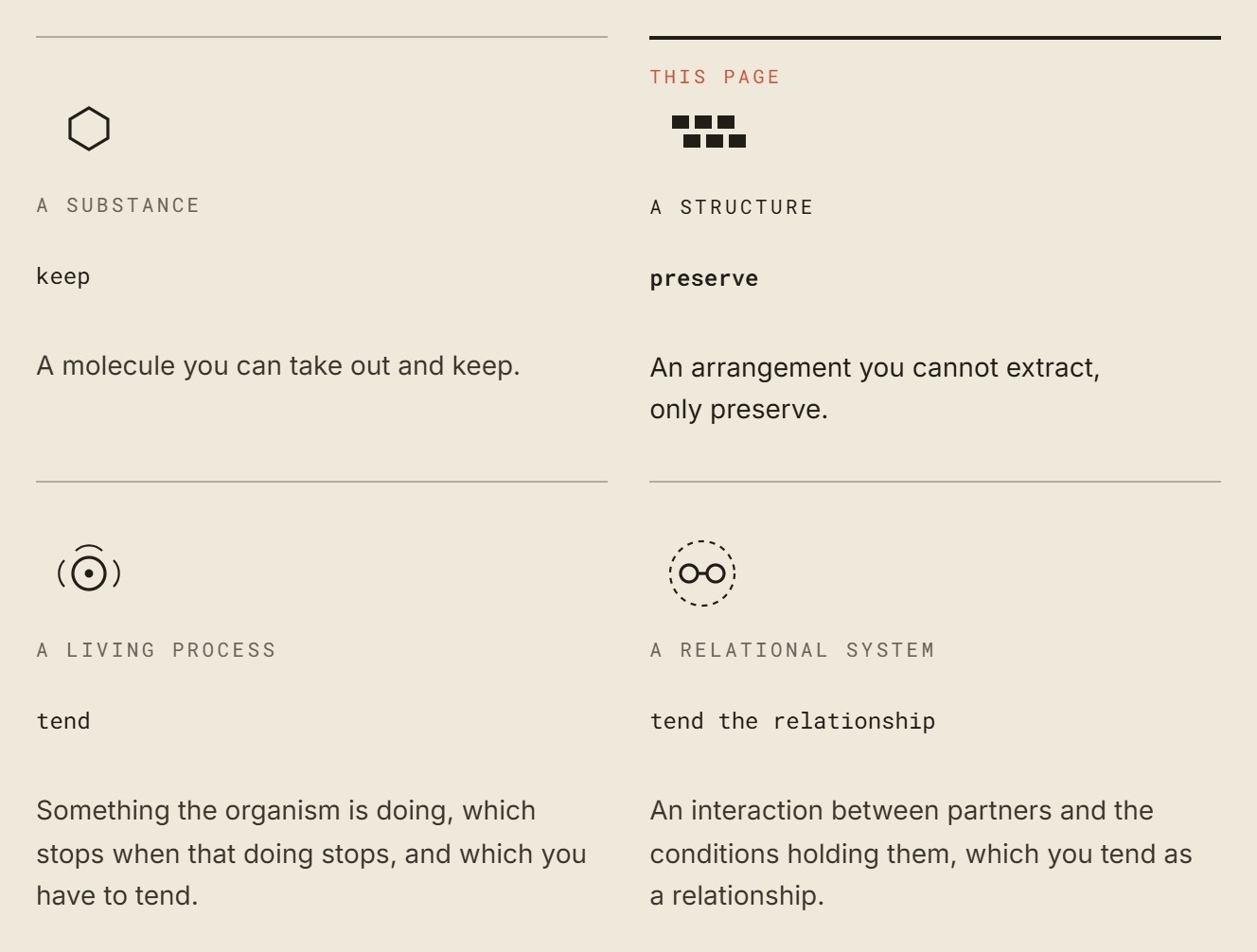
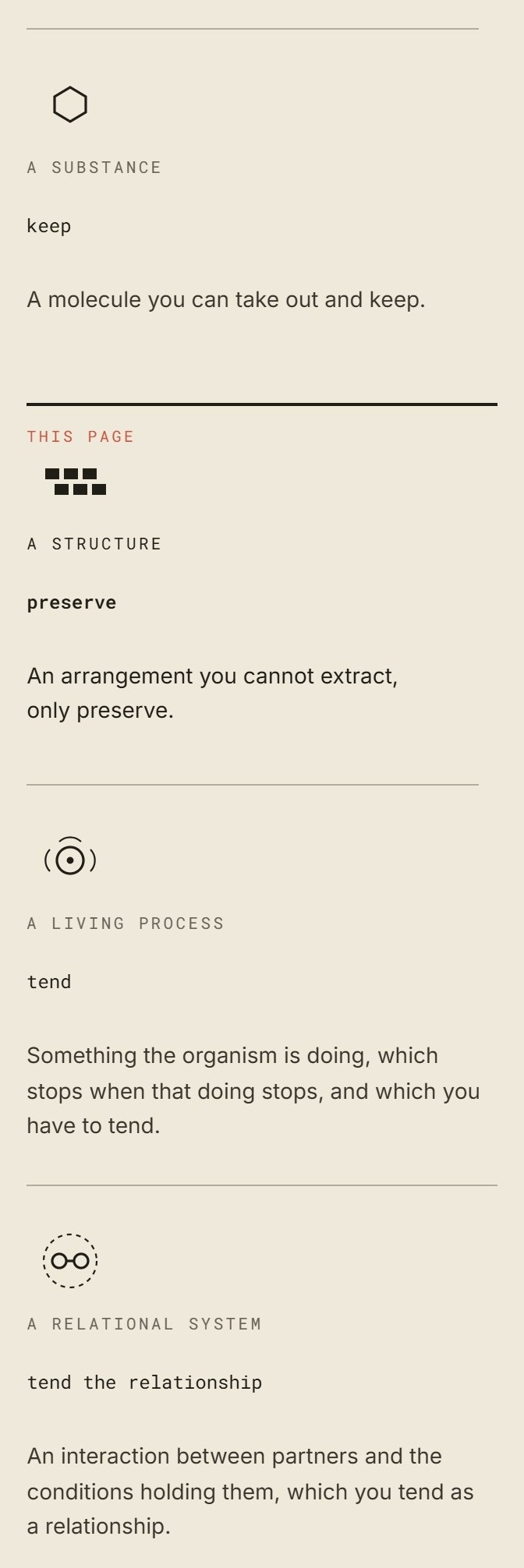
For mycelium, binding is a structure, and your posture is to preserve it. The property is the net. Break the block up and the binding goes, though every gram of fungus and every gram of substrate is still in your hands. The wall does real work inside that net, so a substance is holding the structure up, but the arrangement is the carrier.
Worth noticing what mycelium here is not. In a wood this fungus is a relational system, joined to roots and to its neighbours in exchanges we are only beginning to read. In a container it has been lifted out of all of that and set to work alone. This read is honest about the block. It is not a reading of the fungus.
