The slowest blue
A fungus leaves a blue-green in fallen wood that lasts for centuries. Nobody has yet made it without the fungus.
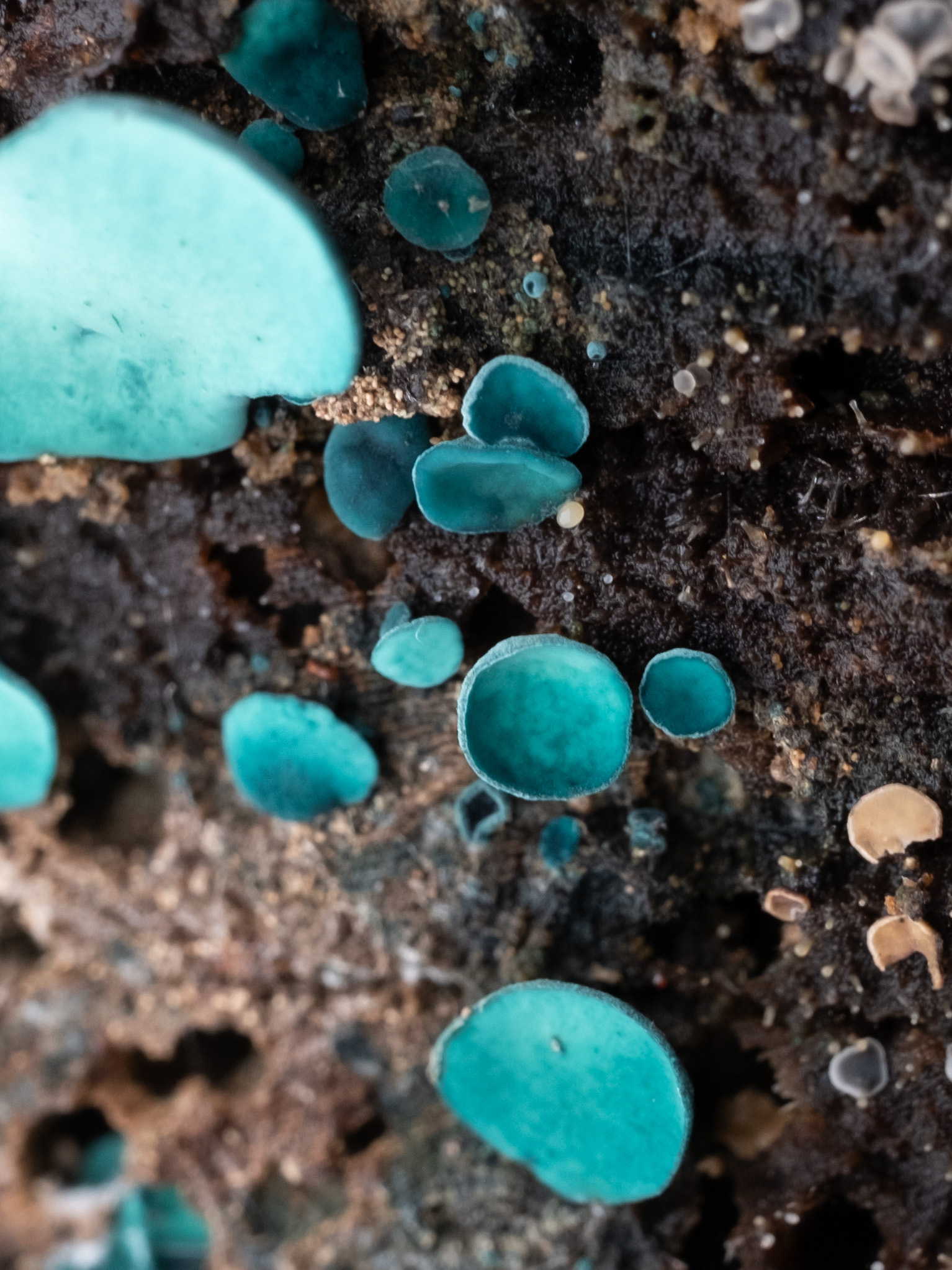
Turn over a fallen branch of oak or beech in a damp wood, and now and then the bare wood underneath is stained a deep blue-green. If you’re lucky, you’ll find tiny turquoise cups on it too.
The colour belongs to a fungus, Chlorociboria. It’s a decomposer, sharing dead wood with beetles, mosses and other fungi, and helping break it down into forest floor. The blue-green, a pigment called xylindein, is what that work leaves behind.
A colour that was always shared
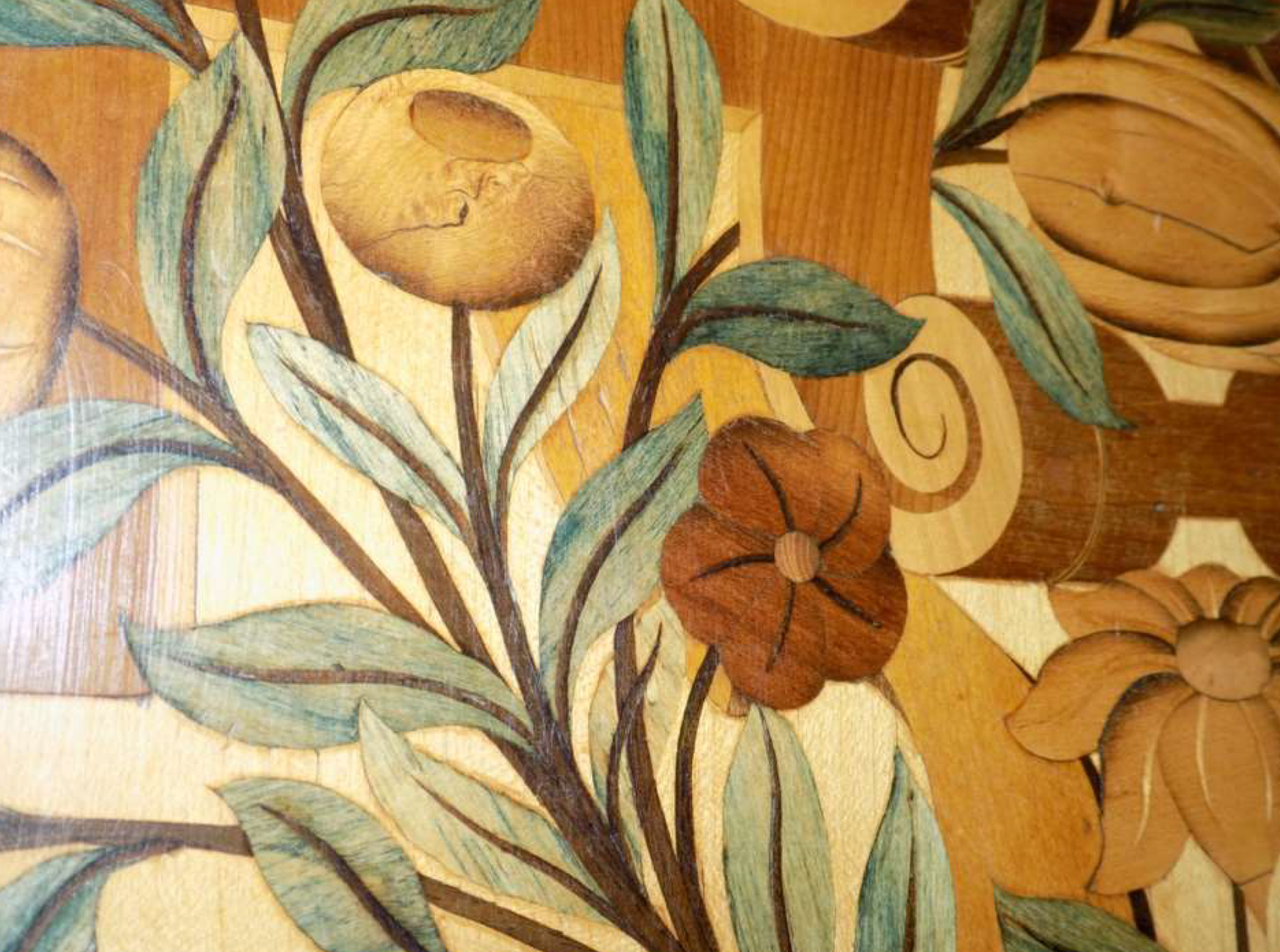
Renaissance woodworkers set this wood into their inlay, for water, grass and parrots. Nobody knows whether they could make the stain happen, or simply gathered it where the forest had made it. Either way, they worked on the fungus’s time.
Until the early 1990s, museum curators thought the blue-green was a dye. Then researchers found fungal threads in the wood.
For centuries, the fungus’s part of the work had gone uncredited.
A slow colour
The pigment lasts. It stands up to sunlight and to washing. But the fungus grows slowly, some strains simply stop making pigment, and the pigment barely dissolves. Chemists can’t easily make it either.
In 2025, a team in the Netherlands moved key pigment genes into koji mould, the fast-growing fungus behind soy sauce. Nothing came out. A similar gene from another fungus worked in the same mould, so something the blue needs didn’t travel with its genes.
The enzyme nobody can read
The last step in making the blue seems to rest on one enzyme, called XLNcnh. It’s labelled a carbonic anhydrase, a family that does a simple job with carbon dioxide and water. That job doesn’t fit the step the pigment needs.
So I used an AI tool to predict its shape.
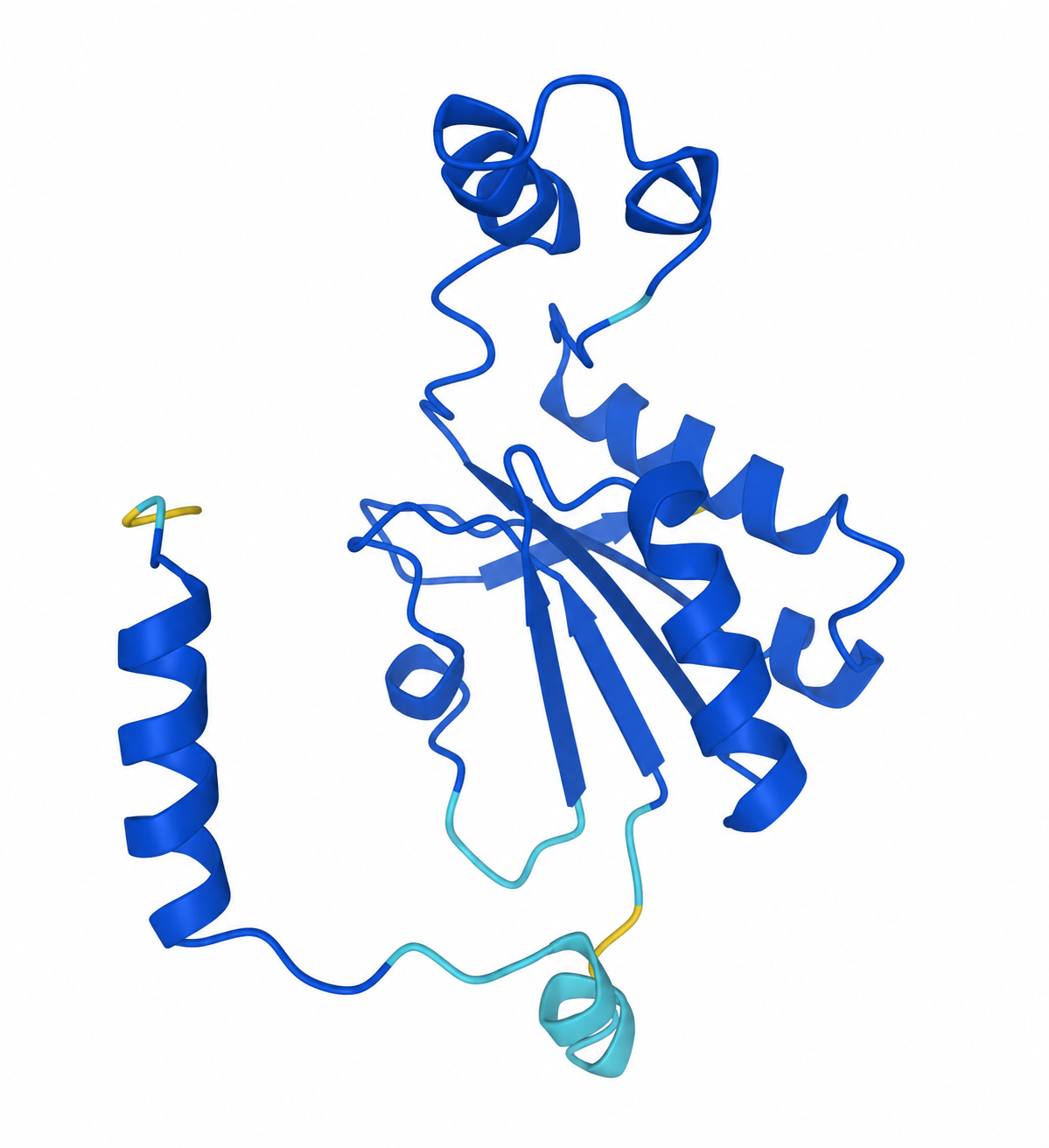
A predicted shape on its own doesn’t tell you much. So I put it into Foldseek, a free search engine for protein shapes. You give it a shape, and it finds known proteins that look most alike. Think of a reverse image search, but for proteins.
Every close match was a carbonic anhydrase whose shape had been measured in a lab.
The shape agrees with the label. It still can’t tell you what the enzyme does.
The fungus knows how to make this blue. We don’t, yet.
Designing with, not over
A lot of design runs on mastery: pick a colour, get it on demand. This blue comes when the fungus makes it, in whatever amount the wood can spare.
Before we ask how to make it faster, we might ask who made it, and what it could give back.
The full Reading
For library members: the full story of how scientists tried to move the blue, a step-by-step guide to predicting and searching the enzyme’s shape yourself, design moves for working with a forest colour, and teaching notes with a blue-green wood walk for students.
AI-Native Biodesign: With Proteins
A 6-week online course, 5 November to 10 December. No biology, coding or lab needed. Each week you take one step on your own project. Founding prices hold until 1 November.
Guo, Y., Navarro-Muñoz, J., Rodenbach, C., et al. (2025). Identification of a biosynthetic gene cluster for the production of the blue-green pigment xylindein by the fungus Chlorociboria aeruginascens. Journal of Natural Products, 88(2), 233–244. doi: doi.org/10.1021/acs.jnatprod.4c00350.
Robinson, S.C. (2022). Cultures of spalting. Encyclopedia, 2(3), 1395–1407. doi: doi.org/10.3390/encyclopedia2030094.
Robinson, S.C., Tudor, D., Snider, H. and Cooper, P.A. (2012). Stimulating growth and xylindein production of Chlorociboria aeruginascens in agar-based systems. AMB Express, 2, 15. doi: doi.org/10.1186/2191-0855-2-15.
van Kempen, M., Kim, S.S., Tumescheit, C., et al. (2024). Fast and accurate protein structure search with Foldseek. Nature Biotechnology, 42, 243–246. doi: doi.org/10.1038/s41587-023-01773-0.
GenBank PP549521.1, the xylindein gene cluster. www.ncbi.nlm.nih.gov/nuccore/PP549521.1
