Masterclass
Design your first protein with AI
A 90-minute hands-on masterclass for designers who work with living matter, and want to do it with care. Free browser tools, no coding, no lab. Thursday 1 October, 17:00 CEST.
From $35. Full refund up to 48 hours before.
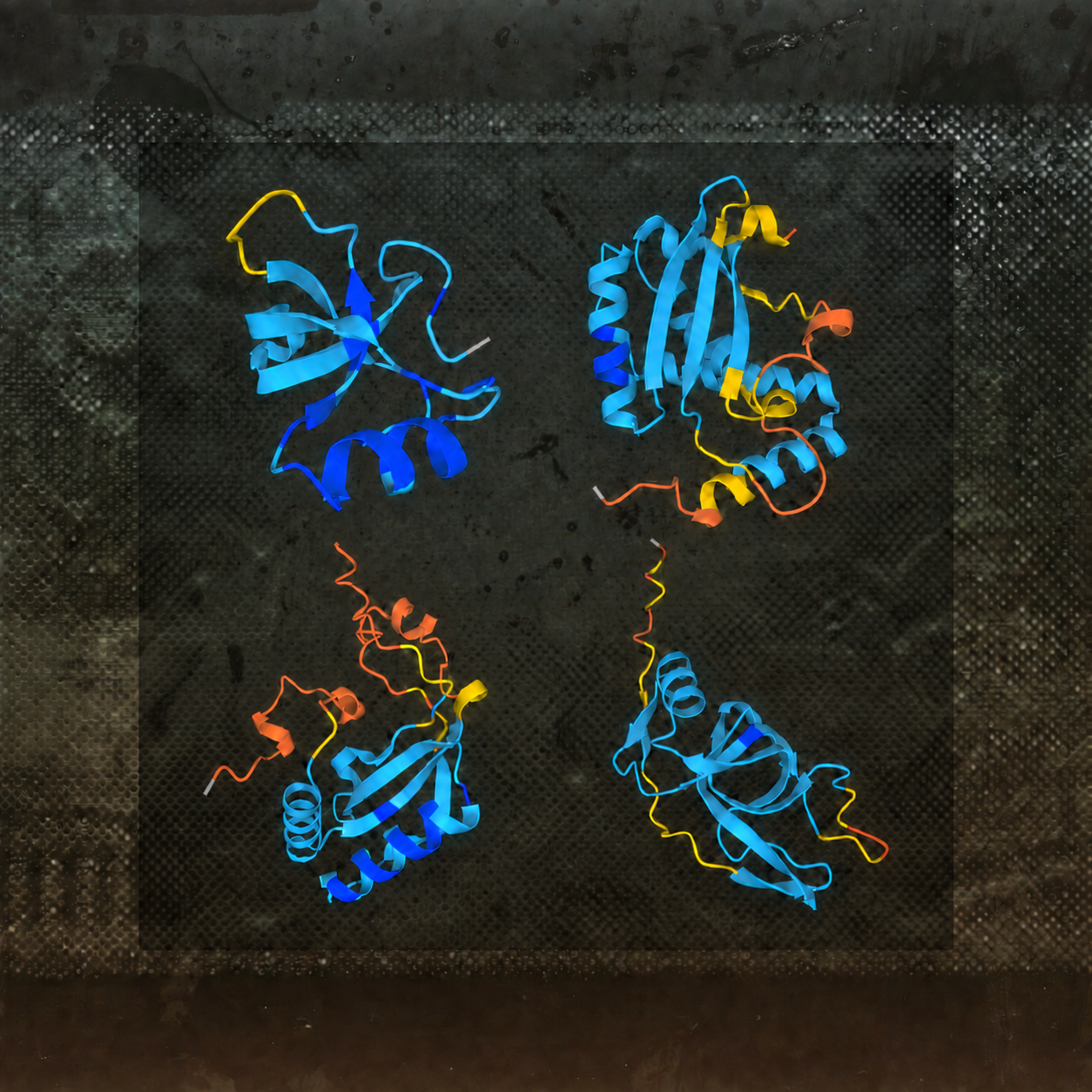
Blue means the model is sure. Yellow and orange mean it's guessing.
A fungus coats its spores in a protein that makes water run off them. A silkworm spins a case of protein around itself while its body changes. Some bacteria make proteins that grip the cellulose in plants, so they can break it down and feed.
Each of these proteins does a job in the life of the organism that makes it. And each life is tangled up with others: the fungus with the damp ground it grows through, the silkworm with the mulberry leaves it eats, the bacteria with the plants they feed on.
Designers meet these proteins later, as mycelium, silk and cellulose. When we make things from living matter, we borrow that work.
Each protein starts as a string of letters. The string folds into a shape, and the shape does the job.
You can now see that shape from your own laptop, in a browser, with a free AI tool, in a few minutes. The heavy work runs on the tool's servers, so your machine only has to hold a browser tab open.
AI makes these proteins easy to change. It can't tell you what a change would mean for the organism that makes the protein, for the other organisms it would meet, or for the people who'd handle it. You have to ask that yourself. In this session we practise asking, with a real protein in front of us.
On 1 October I'll show you how to read a protein's shape closely. Then you'll change it, slowly and on purpose, and notice what your change did to it.
What we'll do
First, 5 minutes on the road we're not taking. AI can now draw a protein from scratch, one no organism has ever made. I'll show you a result I ran before the session, what it cost, and how often designs like it fail in the lab. Then we'll do something slower and more useful to you: working with a protein that already has a life.
1. Read
We fold a small protein from living matter that designers already work with. Before we change anything, we spend time with it. You learn which parts the AI is sure about, which parts it's guessing, and which part does the job for the organism.
2. Redesign it, with care
You make 3 small changes, one at a time, and fold it again after each one. Each time, you notice what you disturbed as well as what you gained. A protein holds together as a whole, so a change in one place can pull on parts far away.
We make the first 2 changes together, step by step. I'm choosing them in my test runs this week, so each one shows you something clear.
For the third change you pick 1 of 3 options I'll put on screen. Every option is one I've already run, so nothing surprises us on the night, and you'll have made the call yourself.
Bring your version to the review at the end. We'll put the 3 options side by side and work out why they came out differently, and what each change gave up.
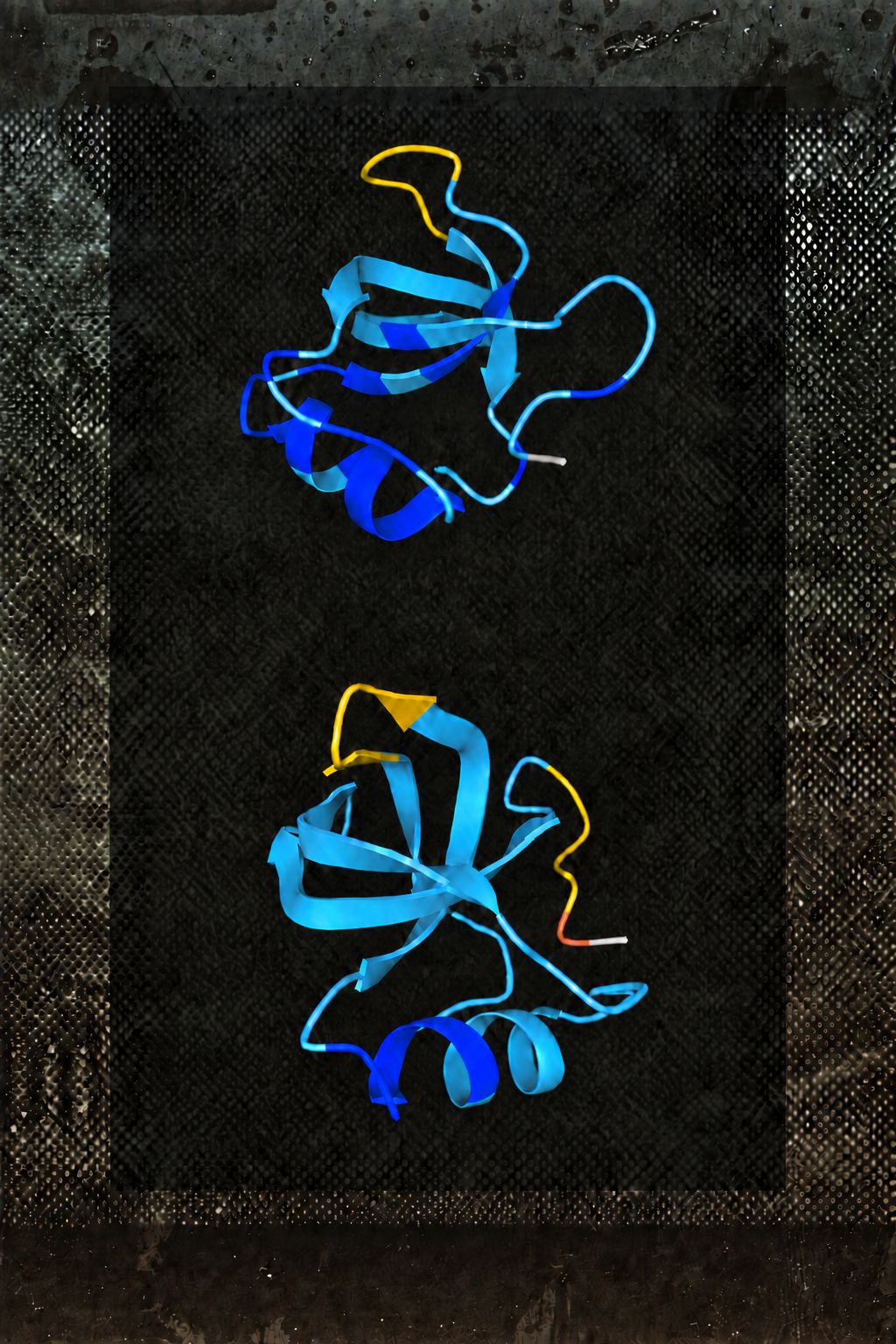
The same protein, before and after one small change. Notice what moved, and what held.
3. Decide, and answer for it
Line your versions up. Pick the one you'd take further and say out loud why. Then write 2 questions.
The first is for a scientist: what would they have to test?
The second is for you: if this protein were ever made, who would it touch? Follow the threads. Start with the organism that would have to make it, often a microbe grown in a tank. Then the other organisms it might meet, and where it would end up when nobody wants it any more. Then the people who'd work with it.
Those 2 questions are the most useful things you'll leave with.
One thing to be clear about before you book. Nothing we do makes a molecule. We make predictions, and questions worth asking. That is still a lot.
What you leave with
- Your own version of a real protein, with the original beside it to compare
- A 3D file of it, to render or prepare for printing
- 2 questions: one for a scientist, and one about who your protein would touch
- A one-page card with the 5 steps, so you can do it again with a protein from living matter you already work with
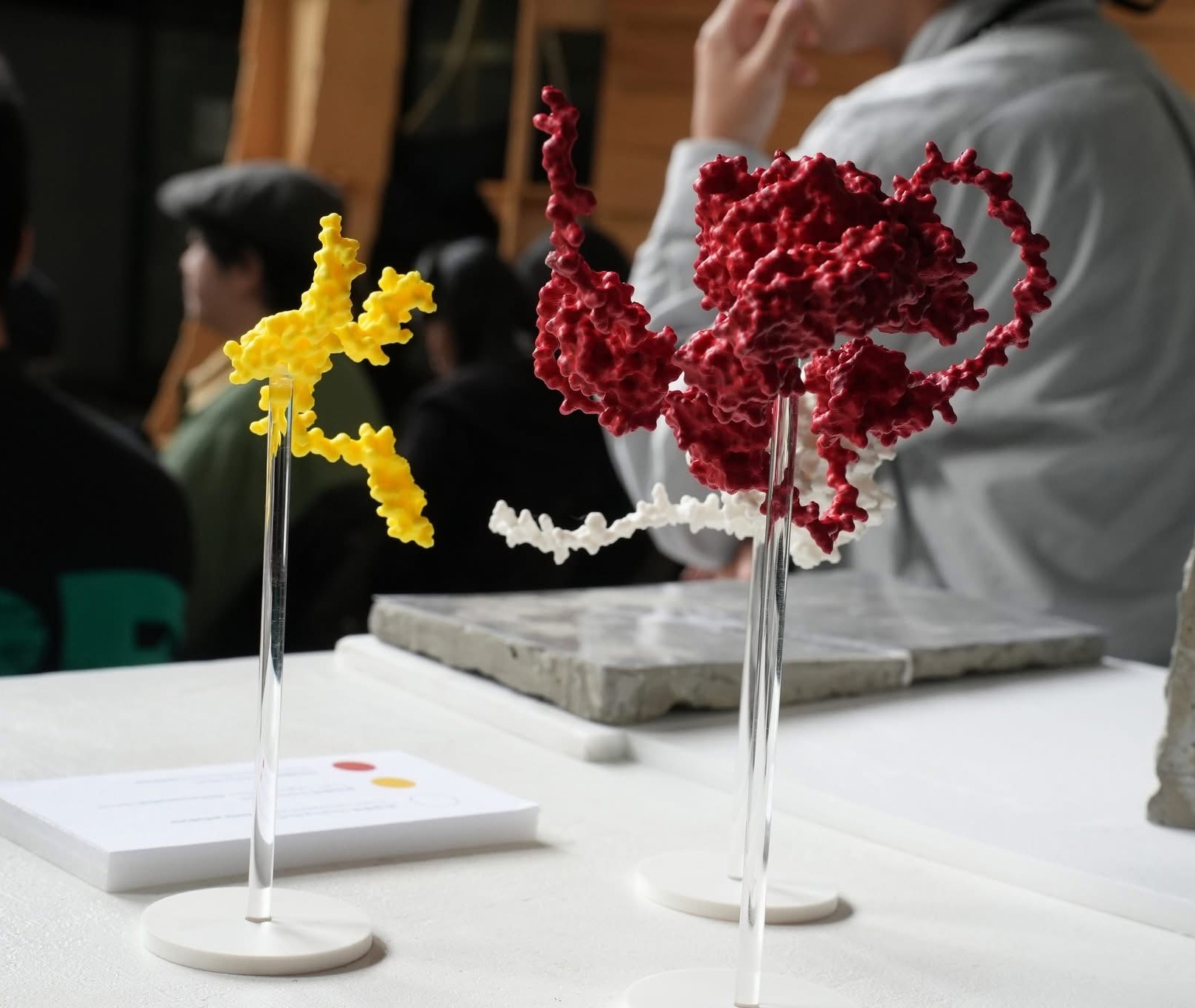
A shape borrowed from living matter, printed so you can hold it. Students made this one at the workshop I ran at Shih Chien University in Taipei, January 2026.
Photo: Shih Chien University, College of Design.
You'll also know what the picture doesn't tell you. A protein that would unfold or clump the moment it met water can get the same confident picture as one that would hold. Confidence is the model's view of its own drawing. It doesn't test anything in the world, and it knows nothing about the organism that would have to make it.
Staying with that uncertainty, instead of hurrying past it, is where design decisions get made. It's most of what I teach.
The tools
We use Boltz-2, an open AI model released in June 2025 by MIT and Recursion. You drive it from your browser. Its licence lets anyone use it for anything, including paid work, which is why I teach on it: what you learn stays yours to use and to share. I'll also show you where it sits next to AlphaFold 3 and the other models, and why the licence matters for your own work.
What you need
A laptop with a recent browser, and a free account on the tool we use. No payment, no install, no coding, no biology background. On Wednesday 30 September I'll send you the link, the steps and a short test run, so you know it works before we start. Everything in the session is explained in plain English, for designers.
When
Thursday 1 October 2026, 17:00 to 18:30 CEST (16:00 London, 11:00 New York). On Zoom.
Can't come live? Every ticket includes the recording. You can also email me your result or a question by Sunday 4 October, and I'll send everyone written answers on Thursday 8 October.
Tickets
These prices end on Monday 28 September at 23:59 CEST.
Programme ticket
$220
For an educator coming on behalf of a course or studio. One seat, plus a pack to run this exercise in your own studio, with laptops and no lab. Receipt in your institution's name. Card payment only.
Questions people ask
Is this a theory session?
No. You'll spend most of the 90 minutes changing a real protein and noticing what happened. The questions about care come out of that work, in step 3. You don't need to have read anything.
What comes after this?
A 4-week live cohort in November, where we design proteins from scratch: choosing what to make, generating it, and working out which designs are worth making at all, and worth anyone's money. I'll give the dates, the price and the number of seats in the last 5 minutes of the masterclass, and your ticket price comes off it. The masterclass stands on its own, so you don't need the cohort to get value out of Thursday.
Do we design a protein from scratch?
No, and that's on purpose. From scratch means 3 AI tools chained together, paid credits, and a result you have no way to judge yet. I'll show you one and tell you what it costs and how often it fails. What you'll do with your hands is change a real protein, one with a living history, and notice what happened. That's the part that carries over to your own work.
Which protein will we use?
A small one from living matter that designers already work with. I'm testing a few now, so the one we fold on the day runs smoothly on a free account. I'll name it, and the organism that makes it, in the setup email the day before.
Is it too technical for me?
No. If you can paste text into a box and press a button, you can do every step. I explain each biology word the first time I use it.
Will my laptop cope?
Yes. The AI model runs on the tool's servers, not on your machine. You need a browser and a working connection, nothing else.
What if the tool is slow on the day?
I'll have every result ready to share in the chat, so you can follow along either way.
Is the session recorded?
Yes. The recording may be offered to other people later. Your camera and your name on screen are up to you. If you share your work in the live review, I'll ask you first.
Can I get a refund?
Yes, a full refund up to 48 hours before the session. After that, you keep the recording and the written answers.
Who's teaching
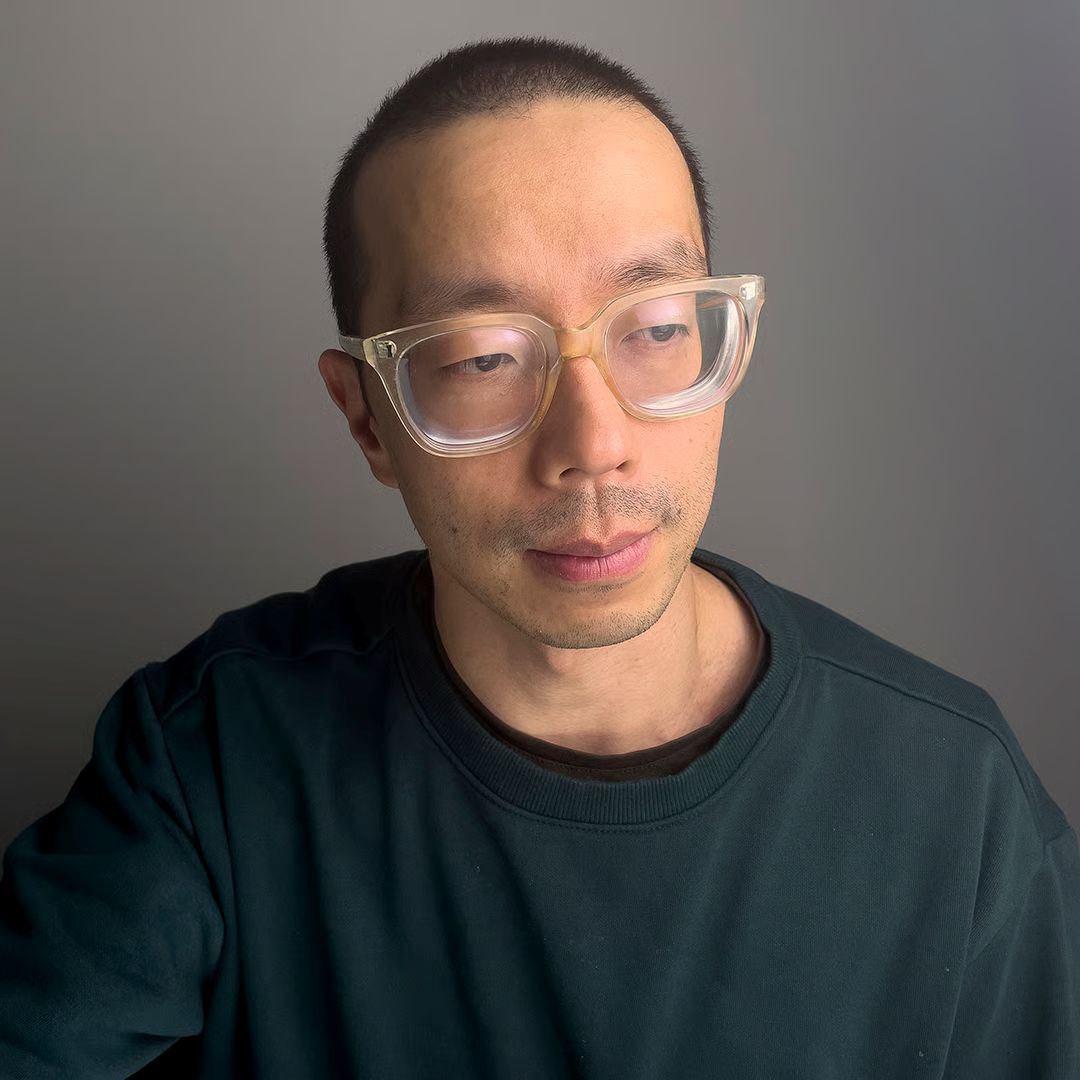
I'm Raphael, and I started in the lab. During my biotechnology degree at UCL I spent a year at Roche in Basel, folding and purifying proteins, and I wrote my final-year thesis on protein folding and drug design. Later I was the lab manager of a malaria research lab at Imperial College London.
Then I moved into design: an MA at the Royal College of Art, a PhD at Queen Mary University of London on computer games played with living microbes, and a postdoc on living matter at TU Delft. I've taught design students at the RCA as a visiting lecturer.
Now I work where the two meet. I won compute time on Isambard-AI, part of the UK's national AI research resource, and in 2026 I've used it to test how AI protein predictions hold up, across about 1,700 predicted structures. In 2025 I ran AlphaFold Futures, a 3-day workshop for designers, with participants from 5 universities. In January 2026 I ran a week-long international design workshop at Shih Chien University's College of Design in Taipei, where students used these tools to design materials for clothing, buildings, cities and medicine. And I run Biodesign Academy, where I write about how living matter works, from the molecule up.
Questions? Reply to any Biodesign Academy email, or write to [email protected].
