Data centres, AI, and living matter
What a data centre owes the living systems around it: Biodesign Academy’s response to the EU’s minimum performance standards for data centres
Europe is setting minimum performance standards for data centres, the buildings that run cloud services and AI. On 26 October 2026, Biodesign Academy sent its feedback to the European Commission’s call for evidence, with a policy brief setting out three recommendations.
This page explains what we asked for, and why. It is also where we will post updates as the standards take shape.
Why a biodesign organisation responded
Biodesign Academy teaches designers, educators and students to work with living matter, such as bacteria, fungi and algae, and the proteins they make, alongside AI models.
That puts us on both sides of a data centre. Many of us use AI tools every day, from general chatbots to models for proteins, DNA and cells. And much of biodesign means growing living matter, which needs steady warmth and clean water.
The question we hear most often from fellow biodesigners is simple: how much water does my AI use, and where? It is a question about the biodesign AI footprint: the energy and water used, and the heat given off, by the data centres that run the AI tools in a biodesign project. Most of it happens far from the studio, in places the designer never sees. We could not answer the question well, because the information is not public. That is part of why we wrote this.
We also know something the heat debate tends to miss: the temperatures at which living matter grows.
Our three recommendations
1.Count growing living matter as a real outlet for waste heat
Data centres give off a lot of heat, and almost none of it is used. The Commission estimates that reusing about half of it would match the heating demand of about four million households. Yet in the first EU reporting exercise, reporting data centres had an overall energy reuse factor of about 1.8%.
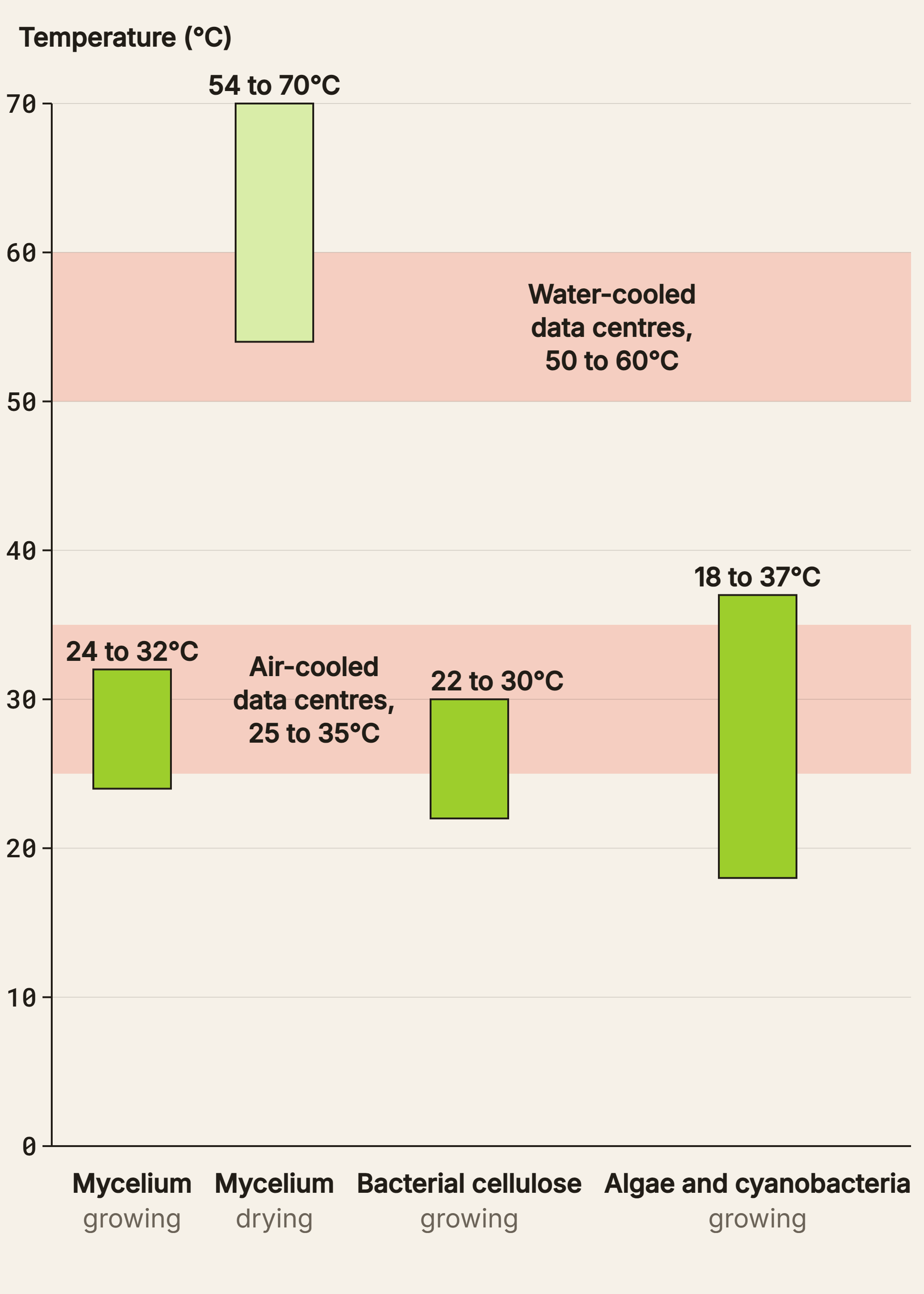
The main problem is that the heat is low in temperature. Air-cooled data centres give off heat at about 25 to 35°C. That is too cool for most heat networks without heat pumps, and most of it comes in summer, when homes need it least.
Living matter grows at exactly these temperatures. Across published processes:
Fungal mycelium, grown for packaging and insulation, is incubated at about 24 to 32°C, then dried at about 54 to 70°C.
Bacterial cellulose, grown for textiles and wound dressings, is grown at about 22 to 30°C.
Algae and cyanobacteria, grown for pigments and living building materials, often grow best between 25 and 37°C, depending on the strain.
We call this biodesign heat reuse: using the low-temperature waste heat from data centres to keep living matter warm while it grows, or to dry what it makes. Heat reuse is usually pictured as heating homes. Growing living matter is different. It needs low, steady heat all year, including in summer, when homes need little.
In one lab study of mycelium composites, about 95% of emissions came from electricity, and drying used more than half of it. Recovered heat could carry part of that load.
Heat from data centres already warms a trout farm in Norway and an algae pilot near Paris. But rules on heat reuse, such as Germany’s and France’s, are written mainly around heat networks.
When the standards test whether heat reuse is feasible, they should consider nearby growers of fungal mycelium, bacterial cellulose, and algae and cyanobacteria, not only heat networks. We ask for clear guidance on how to assess these growers and how their heat counts, and for each site’s available heat, its temperature and amount, to be published so growers can find it.
This is not automatic. It depends on distance, equipment, steady supply and agreements between two industries that rarely work together. Algae also need light, and large fermenters need cooling, not heat. The brief sets out these limits in full.
2.Judge water stress by what rivers need, not only people
Rivers are living systems. How much water flows, and when, shapes the lives of fish, plants and wetlands. In 2021, only 37% of Europe’s surface water bodies had good or high ecological status, and water stress affects 30% of Europe’s population every year.
A data centre can look acceptable when it is judged against human demand alone, and still take water a river already lacks. EU water law already describes what a river needs, through “ecological flows”.
Indicators of water stress for data centres should draw on ecological flows, not only on human withdrawals.
3.Let users see what is behind their tools
Today, a user cannot see which data centre runs their AI tool, or how well it performs. The few AI providers that publish water figures measure different things. Google estimates 0.26 mL for a median Gemini text prompt. Mistral reports about 45 mL for a Le Chat response, counting more of the life cycle. The two numbers cannot be compared, and neither names a site.
Water per prompt is only one part of a biodesign AI footprint, and today nobody outside the companies can measure the whole of it.
The EU will give data centres A to G ratings for energy and water. But individual site data stays confidential, so teachers, students and researchers cannot check or study it.
Biodesign already makes this distinction. Published studies of bacterial cellulose separate water used from water returned.
Link each cloud and AI service to the data centres that run it and to their ratings. Publish per-site data in an open, machine-readable format, and separate water borrowed and returned from water lost.
What this means if you design with living matter
You do not need to wait for the standards to start asking better questions of your tools:
Which provider runs the model I use, and does it publish water and energy figures?
Do those figures name a place, or only an average?
If I grow mycelium, cellulose or algae, where does my heat come from, and could it come from somewhere that is already throwing it away?
The first two questions are where reading your biodesign AI footprint starts. The third is where biodesign heat reuse starts. All three are questions about care: who and what a tool touches, beyond the screen. They sit at the heart of how we teach AI and biodesign at Biodesign Academy.
Questions people ask
The energy and water used, and the heat given off, by the data centres that run the AI tools in a biodesign project. It is often taken to mean water per prompt, but it also includes energy and heat, and it depends on where the work happens.
Using the low-temperature waste heat from data centres to keep living matter warm while it grows, or to dry what it makes. Examples include fungal mycelium, bacterial cellulose, and algae and cyanobacteria.
It depends on the provider, the model, the site and how you count. Published figures range from a fraction of a millilitre to tens of millilitres per response, measured in different ways. A UN University report estimates that the electricity for the world’s data centres took about 4.5 trillion litres of water in 2025, before cooling on site. Without per-site data, nobody outside the companies can check these numbers.
The temperatures match for several processes. Whether it works at a given site depends on distance, heat transfer equipment, backup heat and cost. One engineering study found that warming an algae system with waste heat was technically feasible but raised costs a lot. We ask for the option to be assessed, not assumed.
It is the share of a data centre’s energy that is reused outside it, for example as heat for homes, farms or growers. A factor of 0.20 means 20% is reused.
The pattern of flow, how much, when and for how long, that a river needs to stay healthy under the EU Water Framework Directive.
Yes. Anyone can give feedback on the Commission’s Have Your Say portal until 14 December 2026.
You are welcome to use and adapt our brief. It is licensed CC BY 4.0.
Read the full brief
Cite asKim, R. (2026) Data centres, AI, and living matter: recommendations for EU minimum performance standards. Policy brief, Biodesign Academy Ltd, October 2026. https://doi.org/10.5281/zenodo.23642473
LicenceCC BY 4.0. You may share and adapt it, with credit.
Updates
Biodesign Academy is a small education company that teaches designers, educators and students to work with living matter and AI. It is run by Dr Raphael Kim, whose research, published mainly at ACM venues, explores how people design with living matter and computing.
Questions, or want to work on this with us? [email protected]
